
Cve Mcp
What is Cve Mcp
CVE-MCP is a server designed to retrieve detailed CVE (Common Vulnerabilities and Exposures) information using the CVE.ORG API, providing comprehensive vulnerability data including descriptions, CWEs (Common Weakness Enumerations), and CVSS (Common Vulnerability Scoring System) scores.
Use cases
Use cases for CVE-MCP include integrating CVE data into development tools for real-time vulnerability insights, enhancing security practices in software development, and supporting security audits by providing detailed vulnerability information.
How to use
To use CVE-MCP, integrate it with Visual Studio Code by adding a specific configuration in the settings.json file. This allows developers to access real-time CVE data directly within the editor, enhancing their workflow.
Key features
Key features of CVE-MCP include comprehensive CVE information retrieval, a robust and extensible MCP server for seamless integration, Docker support for easy deployment, and compatibility with VS Code for enhanced developer workflows.
Where to use
CVE-MCP can be used in software development environments, security analysis, and vulnerability management, where real-time access to CVE data is crucial for maintaining secure applications.
Clients Supporting MCP
The following are the main client software that supports the Model Context Protocol. Click the link to visit the official website for more information.





Overview
What is Cve Mcp
CVE-MCP is a server designed to retrieve detailed CVE (Common Vulnerabilities and Exposures) information using the CVE.ORG API, providing comprehensive vulnerability data including descriptions, CWEs (Common Weakness Enumerations), and CVSS (Common Vulnerability Scoring System) scores.
Use cases
Use cases for CVE-MCP include integrating CVE data into development tools for real-time vulnerability insights, enhancing security practices in software development, and supporting security audits by providing detailed vulnerability information.
How to use
To use CVE-MCP, integrate it with Visual Studio Code by adding a specific configuration in the settings.json file. This allows developers to access real-time CVE data directly within the editor, enhancing their workflow.
Key features
Key features of CVE-MCP include comprehensive CVE information retrieval, a robust and extensible MCP server for seamless integration, Docker support for easy deployment, and compatibility with VS Code for enhanced developer workflows.
Where to use
CVE-MCP can be used in software development environments, security analysis, and vulnerability management, where real-time access to CVE data is crucial for maintaining secure applications.
Clients Supporting MCP
The following are the main client software that supports the Model Context Protocol. Click the link to visit the official website for more information.
Content
CVE MCP Project
The CVE MCP Project is a robust server designed to retrieve detailed CVE information from the CVE API hosted by MITRE. It provides users with comprehensive vulnerability data, including descriptions, CWEs, CVSS scores, and more, all in one place.
MCP (Model Context Protocol) is a protocol designed to enable seamless communication between tools and models. Learn more about MCP on the official MCP website.
Features
- Comprehensive CVE Information: Fetch detailed vulnerability data, including descriptions, CWEs, and CVSS scores, directly from the CVE API.
- MCP Server: Serve data through a robust and extensible MCP server for seamless integration with other tools.
- Docker Support: Easily deploy the server using Docker for a consistent and portable runtime environment.
- VS Code Compatibility: Integrate with VS Code MCP for enhanced developer workflows and real-time vulnerability insights.
Usage
Using the MCP for VS Code
The CVE MCP server can be integrated with Visual Studio Code to enhance your development workflow by providing real-time CVE data directly within the editor.
Configuration
To configure the CVE MCP server in VS Code, add the following entry to your settings.json file:
Steps to Use
- Open your
settings.jsonfile in VS Code. - Add the configuration snippet above to register the CVE MCP server.
- Save the file and restart VS Code.
- The CVE MCP server will now be available for use within VS Code.
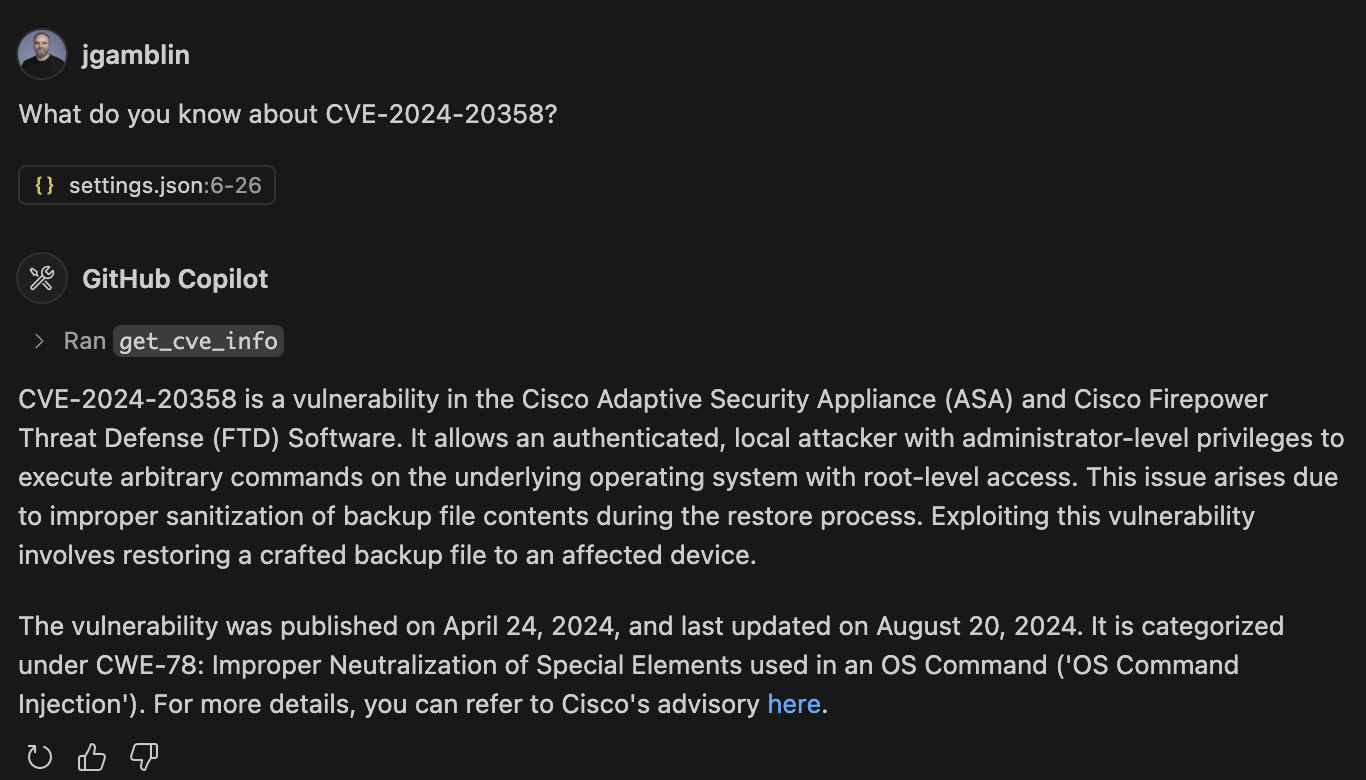
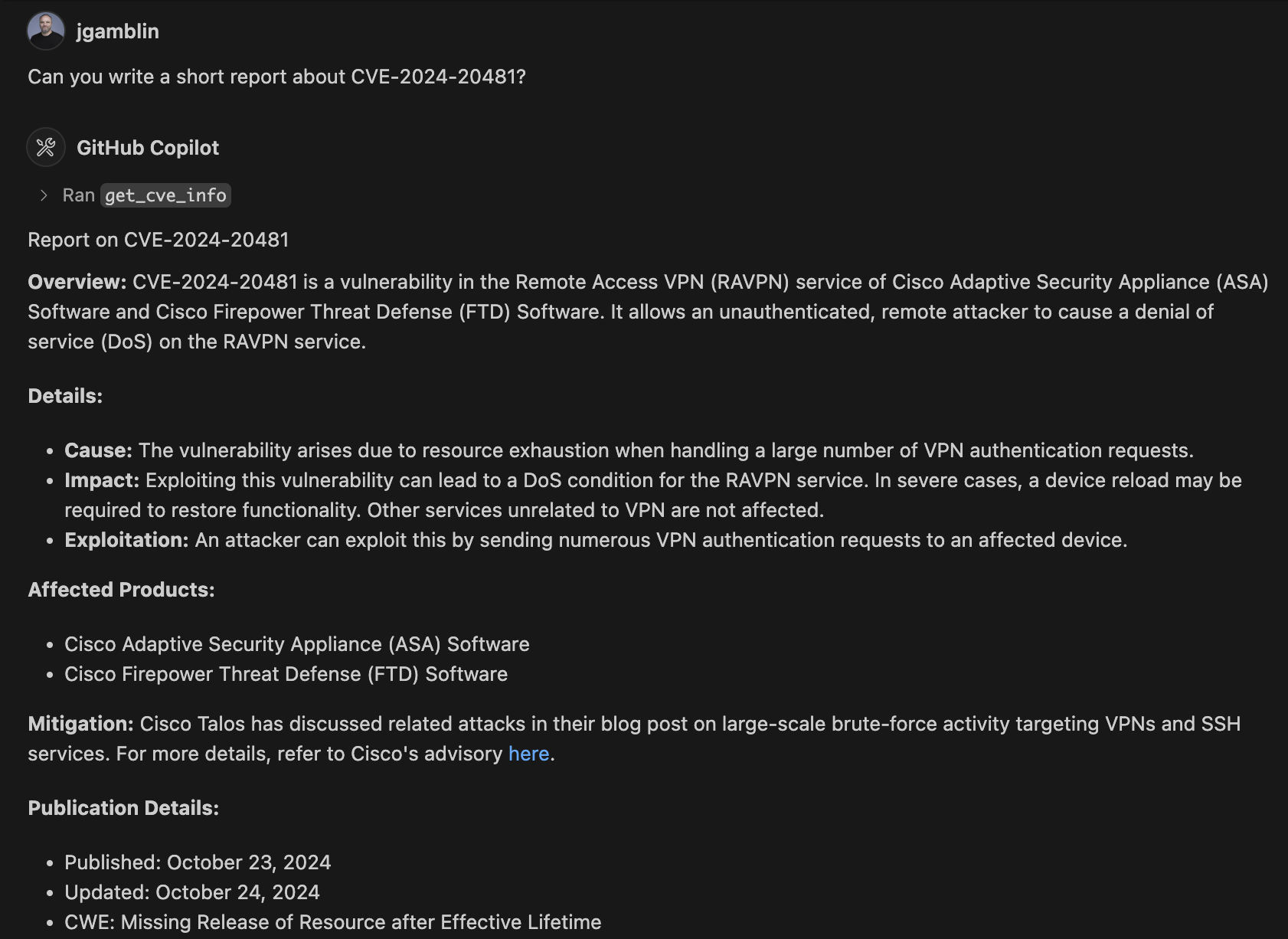
Example Output
Below are example outputs from the CVE MCP server:
Official Resources
For more information about MCP integration in VS Code, refer to the following resources:
Running the MCP Server Locally
To start the MCP server locally, run:
python CVE_MCP.py
Once the server is running, you can make requests to retrieve CVE details by specifying the CVE ID.
Example Request
To get details for a specific CVE, use the following format:
GET /cve/<CVE-ID>
Replace <CVE-ID> with the actual CVE identifier (e.g., CVE-2023-23397).
Prerequisites
- Python 3.13 or higher
- Docker (optional, for containerized deployment)
Project Structure
CVE_MCP.py               # Main entry point for the MCP server
test_cve_mcp.py          # Test script for the MCP server
requirements.txt         # Project dependencies
Dockerfile               # Docker configuration
LICENSE                  # License information
README.md                # Project documentation
Setup Instructions
1. Clone the Repository
git clone <repository-url>
cd CVE-MCP
2. Install Dependencies
It is recommended to use a virtual environment. You can create one using venv or conda. Then, install the required packages:
pip install -r requirements.txt
Docker Deployment
1. Build the Docker Image
To build the Docker container, run:
docker build -t cve_mcp .
2. Run the Docker Container
Run the container and expose it on port 8000:
docker run -p 8000:8000 cve_mcp
The MCP server will now be accessible at http://localhost:8000.
Known Issues
- Ensure the CVE API headers are correctly configured.
- The Dockerfile assumes
mcpois installed and available in the container.
FAQ
What is MCP?
MCP (Model Context Protocol) is a protocol designed to enable seamless communication between tools and models. Learn more about MCP on the official MCP website.
How do I update dependencies?
Run the following command:
pip install --upgrade -r requirements.txt
Contributing
Contributions are welcome! Please feel free to submit a pull request or open an issue for any enhancements or bug fixes.
License
This project is licensed under the MIT License. See the LICENSE file for more details.


Dev Tools Supporting MCP
The following are the main code editors that support the Model Context Protocol. Click the link to visit the official website for more information.







