
Codamcpserver
What is Codamcpserver
CodaMcpServer is an implementation of a Model Context Protocol (MCP) server designed for seamless integration with Coda’s API, facilitating document, table, and data management.
Use cases
Use cases include automating data retrieval from Coda documents, integrating Coda tables into web applications, and managing data workflows within organizations.
How to use
To use CodaMcpServer, clone or fork the repository, set up a .env file with your Coda API key, install dependencies using npm, compile TypeScript files, and run the server on port 8000.
Key features
Key features include table operations (fetching tables, retrieving specific data, getting column information), row management (fetching, upserting, and deleting rows), and column operations (fetching column details and metadata).
Where to use
CodaMcpServer can be used in various fields such as project management, data analysis, and any application requiring document and data manipulation through Coda’s API.
Clients Supporting MCP
The following are the main client software that supports the Model Context Protocol. Click the link to visit the official website for more information.





Overview
What is Codamcpserver
CodaMcpServer is an implementation of a Model Context Protocol (MCP) server designed for seamless integration with Coda’s API, facilitating document, table, and data management.
Use cases
Use cases include automating data retrieval from Coda documents, integrating Coda tables into web applications, and managing data workflows within organizations.
How to use
To use CodaMcpServer, clone or fork the repository, set up a .env file with your Coda API key, install dependencies using npm, compile TypeScript files, and run the server on port 8000.
Key features
Key features include table operations (fetching tables, retrieving specific data, getting column information), row management (fetching, upserting, and deleting rows), and column operations (fetching column details and metadata).
Where to use
CodaMcpServer can be used in various fields such as project management, data analysis, and any application requiring document and data manipulation through Coda’s API.
Clients Supporting MCP
The following are the main client software that supports the Model Context Protocol. Click the link to visit the official website for more information.
Content
MCP Server - Coda.io
A Model Context Protocol (MCP) server implementation for seamless integration with Coda’s API, providing various tools for document, table, and data management.
Features
- Table Operations
- Fetch all tables from a document
- Retrieve specific table data
- Get table columns information
- Row Management
- Fetch rows from tables
- Upsert (insert/update) rows
- Delete rows
- Column Operations
- Fetch specific column details
- Get column metadata
Prerequisites
- Node.js (v20 or higher)
- A Coda API key
- TypeScript knowledge (for development)
Environment Setup
- Clone or fork this repository in Replit
- Create a
.envfile in the root directory:PORT=8000 CODA_API_KEY=your_coda_api_key_here - Replace
your_coda_api_key_herewith your actual Coda API key
Installation
The project uses npm for dependency management. To install dependencies:
npm install
Building the Project
Compile TypeScript files to JavaScript:
npx tsc
Running the Server
After building, start the server:
node dist/index.js
Or use the combined command:
npm install && npx tsc && node dist/index.js
The server will start on port 8000 by default, with the following endpoints available:
- GET
/sse- SSE connection endpoint - POST
/messages- Message handling endpoint
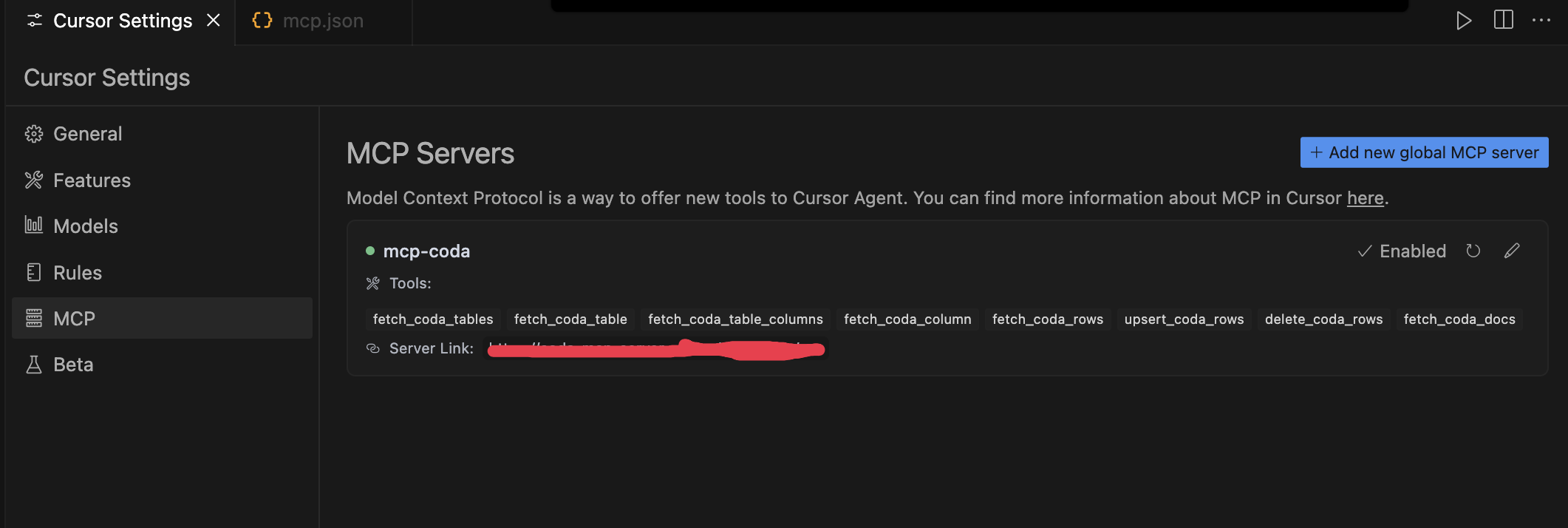
Available Tools
-
fetch-coda-docs- Fetches all available Coda documents
- Optional parameters: isOwner, limit
-
fetch-coda-tables- Fetches all tables from a specified document
- Required parameter: docId
-
fetch-coda-table- Fetches a specific table from a document
- Required parameters: docId, tableId
-
fetch-coda-table-columns- Retrieves columns information for a specific table
- Required parameters: docId, tableId
-
fetch-coda-rows- Fetches rows from a specified table
- Required parameters: docId, tableId
-
upsert-coda-rows- Inserts or updates rows in a table
- Required parameters: docId, tableId, rows
-
delete-coda-rows- Deletes specified rows from a table
- Required parameters: docId, tableId, rowIds
Error Handling
The server implements comprehensive error handling:
- Environment variable validation
- API response validation
- Request parameter validation
- Proper error messages and logging
Development
The project is structured as follows:
src/
├── tools/           # Individual tool implementations
│   ├── fetch-coda-docs.tool.ts
│   ├── fetch-coda-tables.tool.ts
│   └── ...
└── index.ts        # Main server implementation
Built With
- Express.js - Web framework
- @modelcontextprotocol/sdk - MCP implementation
- Zod - Runtime type checking
- dotenv - Environment configuration
Known Limitations and Future Improvements
The current implementation of tools requires several improvements:
- Enhanced JSON response handling and formatting
- Implementation of pagination for large datasets
- Better error handling and retry mechanisms
- Rate limiting implementation
- Batch processing for large operations
- Caching mechanisms for frequently accessed data
- There is more API tools to implement based on the documentation
MCP Client Implementation Example
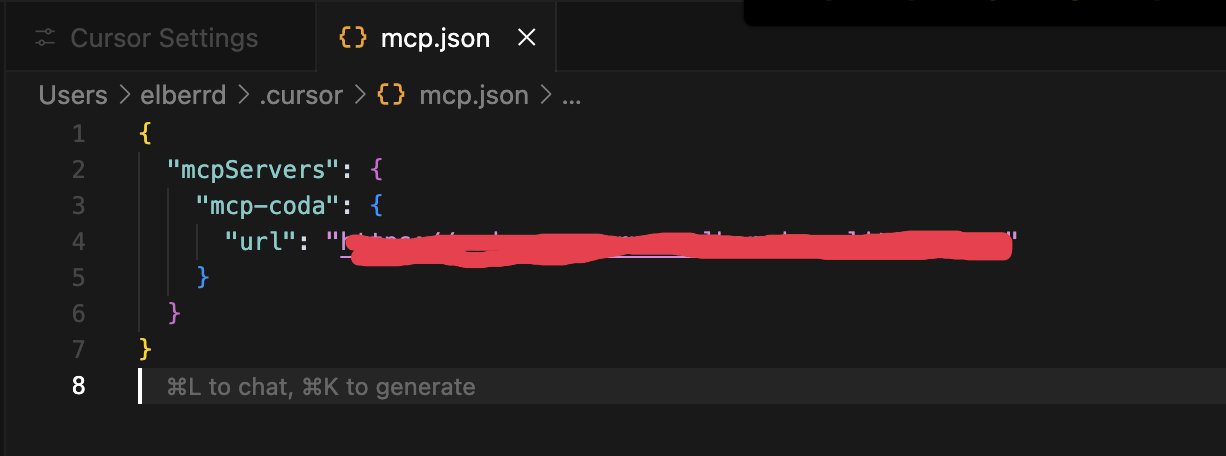
Here are examples of how to implement this MCP server in Cursor:
-
Configure the MCP server in Cursor’s
mcp.json:
-
Enable and use the available tools in Cursor’s settings:
License
This project is licensed under the ISC License.
Dev Tools Supporting MCP
The following are the main code editors that support the Model Context Protocol. Click the link to visit the official website for more information.







