
Mcp Medsam
What is Mcp Medsam
MCP-MedSAM is a lightweight medical segmentation model designed for efficient training using a single GPU. It is based on a novel variant of MedSAM, which integrates a pre-trained tiny Vision Transformer (ViT) and employs innovative prompts and a modality-based data sampling strategy.
Use cases
Use cases for MCP-MedSAM include segmenting tumors in radiological images, identifying anatomical structures in pathology slides, and assisting in automated diagnosis by providing accurate image segmentation.
How to use
To use MCP-MedSAM, download the inference code and model weights from the provided link. The training code will be released soon, allowing users to train the model on their own datasets.
Key features
Key features of MCP-MedSAM include its lightweight architecture, the use of a pre-trained tiny ViT, the introduction of modality and content prompts, and a unique data sampling strategy that enhances training efficiency.
Where to use
MCP-MedSAM can be used in various medical imaging fields, including radiology, pathology, and any domain requiring precise segmentation of medical images.
Clients Supporting MCP
The following are the main client software that supports the Model Context Protocol. Click the link to visit the official website for more information.





Overview
What is Mcp Medsam
MCP-MedSAM is a lightweight medical segmentation model designed for efficient training using a single GPU. It is based on a novel variant of MedSAM, which integrates a pre-trained tiny Vision Transformer (ViT) and employs innovative prompts and a modality-based data sampling strategy.
Use cases
Use cases for MCP-MedSAM include segmenting tumors in radiological images, identifying anatomical structures in pathology slides, and assisting in automated diagnosis by providing accurate image segmentation.
How to use
To use MCP-MedSAM, download the inference code and model weights from the provided link. The training code will be released soon, allowing users to train the model on their own datasets.
Key features
Key features of MCP-MedSAM include its lightweight architecture, the use of a pre-trained tiny ViT, the introduction of modality and content prompts, and a unique data sampling strategy that enhances training efficiency.
Where to use
MCP-MedSAM can be used in various medical imaging fields, including radiology, pathology, and any domain requiring precise segmentation of medical images.
Clients Supporting MCP
The following are the main client software that supports the Model Context Protocol. Click the link to visit the official website for more information.
Content
MCP-MedSAM
Pytorch Implementation of the paper:
“MCP-MedSAM: A Powerful Lightweight Medical Segment Anything Model Trained with a Single GPU in Just One Day”
📄 Overview
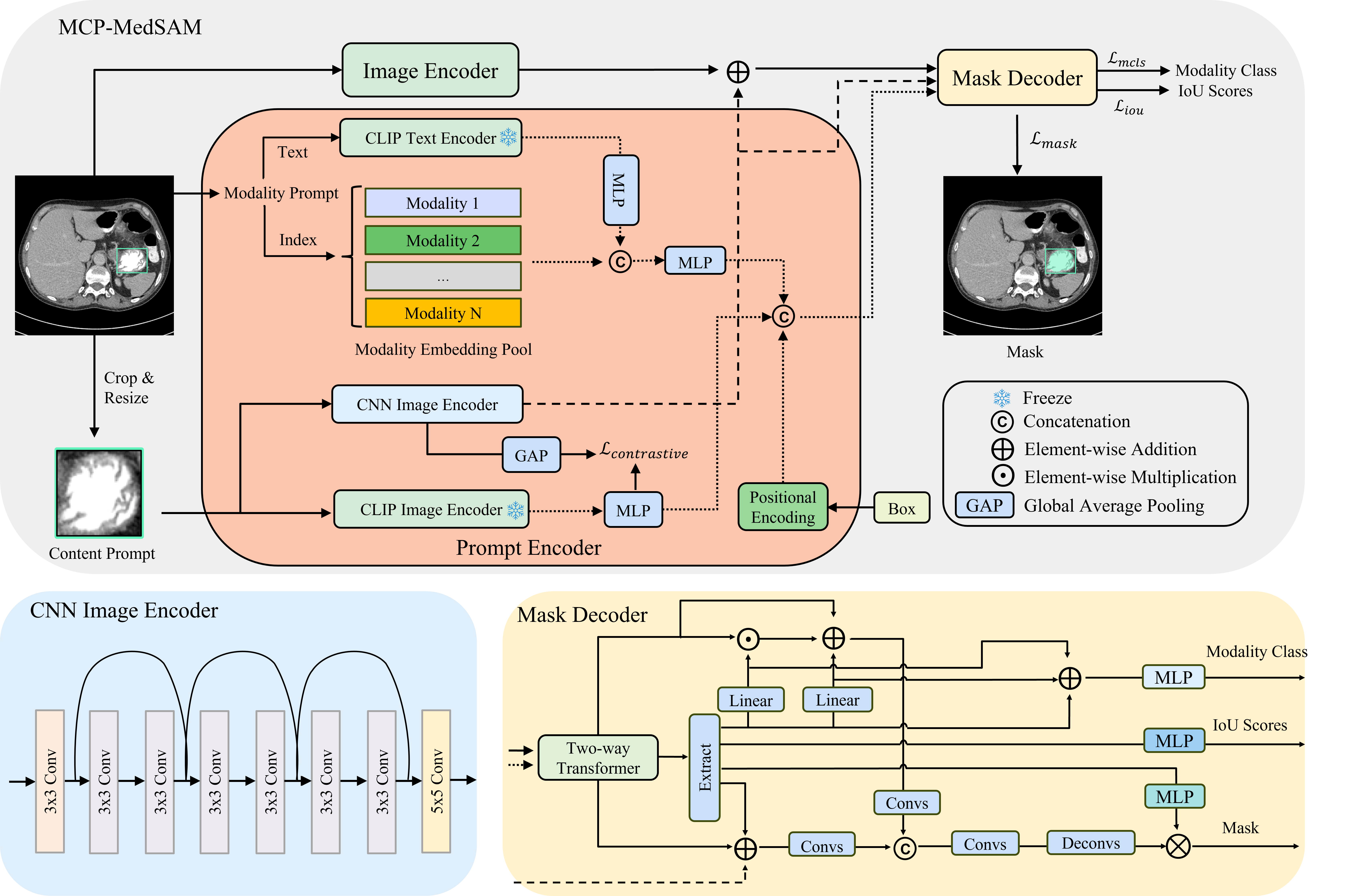
This work proposes a lightweight variant of MedSAM by integrating:
- A pre-trained Tiny ViT as the vision backbone
- Two novel prompt types:
- Modality Prompt
- Content Prompt
- A modified mask decoder adapted to these prompts
To further improve performance across imaging modalities, we introduce a modality-aware data sampling strategy that ensures better balance and generalization.
With these enhancements, our model achieves strong multi-modality segmentation performance, and can be trained in approximately 1 day on a single A100 (40GB) GPU.
Requirements
- Python==3.10.14
- torch==2.0.0
- torchvision==0.15.0
- transformers==4.49.0
Training and Inference
Training and inference can be done by running train.py and infer.py. Additionally, we also release the model weight for inference, which can be downloaded from here. Furthermore, MCP-MedSAM has also been uploaded to the Hugging Face, including pre-trained weights as well.
Citation
@article{lyu2024mcp,
  title={MCP-MedSAM: A Powerful Lightweight Medical Segment Anything Model Trained with a Single GPU in Just One Day},
  author={Lyu, Donghang and Gao, Ruochen and Staring, Marius},
  journal={arXiv preprint arXiv:2412.05888},
  year={2024}
}
Dev Tools Supporting MCP
The following are the main code editors that support the Model Context Protocol. Click the link to visit the official website for more information.







