
Memory Plus
What is Memory Plus
Memory-Plus is a lightweight, local Retrieval-Augmented Generation (RAG) memory store designed for MCP agents. It enables the recording, retrieval, updating, deletion, and visualization of persistent ‘memories’ across sessions, making it ideal for developers working with multiple AI coders.
Use cases
Use cases for Memory-Plus include managing project notes, tracking ideas during development, enhancing AI interactions by allowing the AI to remember user preferences, and visualizing relationships between different pieces of information.
How to use
To use Memory-Plus, first obtain a Google API Key and set it in your environment. Then, install the required UV runtime. After installation, you can start recording and managing memories through the provided functionalities such as saving, searching, updating, and visualizing memories.
Key features
Key features of Memory-Plus include: 1) Record Memories: Save user data and context. 2) Retrieve Memories: Search past entries by keywords. 3) Recent Memories: Quickly fetch the last N items. 4) Update Memories: Modify existing entries. 5) Visualize Memories: Interactive graph clusters. 6) File Import: Ingest documents into memory. 7) Delete Memories: Remove unwanted entries.
Where to use
Memory-Plus can be used in various fields including software development, AI research, and personal productivity, particularly for anyone utilizing AI coders like Windsurf, Cursor, or Copilot.
Clients Supporting MCP
The following are the main client software that supports the Model Context Protocol. Click the link to visit the official website for more information.





Overview
What is Memory Plus
Memory-Plus is a lightweight, local Retrieval-Augmented Generation (RAG) memory store designed for MCP agents. It enables the recording, retrieval, updating, deletion, and visualization of persistent ‘memories’ across sessions, making it ideal for developers working with multiple AI coders.
Use cases
Use cases for Memory-Plus include managing project notes, tracking ideas during development, enhancing AI interactions by allowing the AI to remember user preferences, and visualizing relationships between different pieces of information.
How to use
To use Memory-Plus, first obtain a Google API Key and set it in your environment. Then, install the required UV runtime. After installation, you can start recording and managing memories through the provided functionalities such as saving, searching, updating, and visualizing memories.
Key features
Key features of Memory-Plus include: 1) Record Memories: Save user data and context. 2) Retrieve Memories: Search past entries by keywords. 3) Recent Memories: Quickly fetch the last N items. 4) Update Memories: Modify existing entries. 5) Visualize Memories: Interactive graph clusters. 6) File Import: Ingest documents into memory. 7) Delete Memories: Remove unwanted entries.
Where to use
Memory-Plus can be used in various fields including software development, AI research, and personal productivity, particularly for anyone utilizing AI coders like Windsurf, Cursor, or Copilot.
Clients Supporting MCP
The following are the main client software that supports the Model Context Protocol. Click the link to visit the official website for more information.
Content





Memory-Plus
A lightweight, local Retrieval-Augmented Generation (RAG) memory store for MCP agents. Memory-Plus lets your agent record, retrieve, update, and visualize persistent “memories”—notes, ideas, and session context—across runs.
🏆 First Place at the Infosys Cambridge AI Centre Hackathon!
Key Features
- Record Memories:Save user data, ideas, and important context.
- Retrieve Memories:Search by keywords or topics over past entries.
- Recent Memories:Fetch the last N items quickly.
- Update Memories:Append or modify existing entries seamlessly.
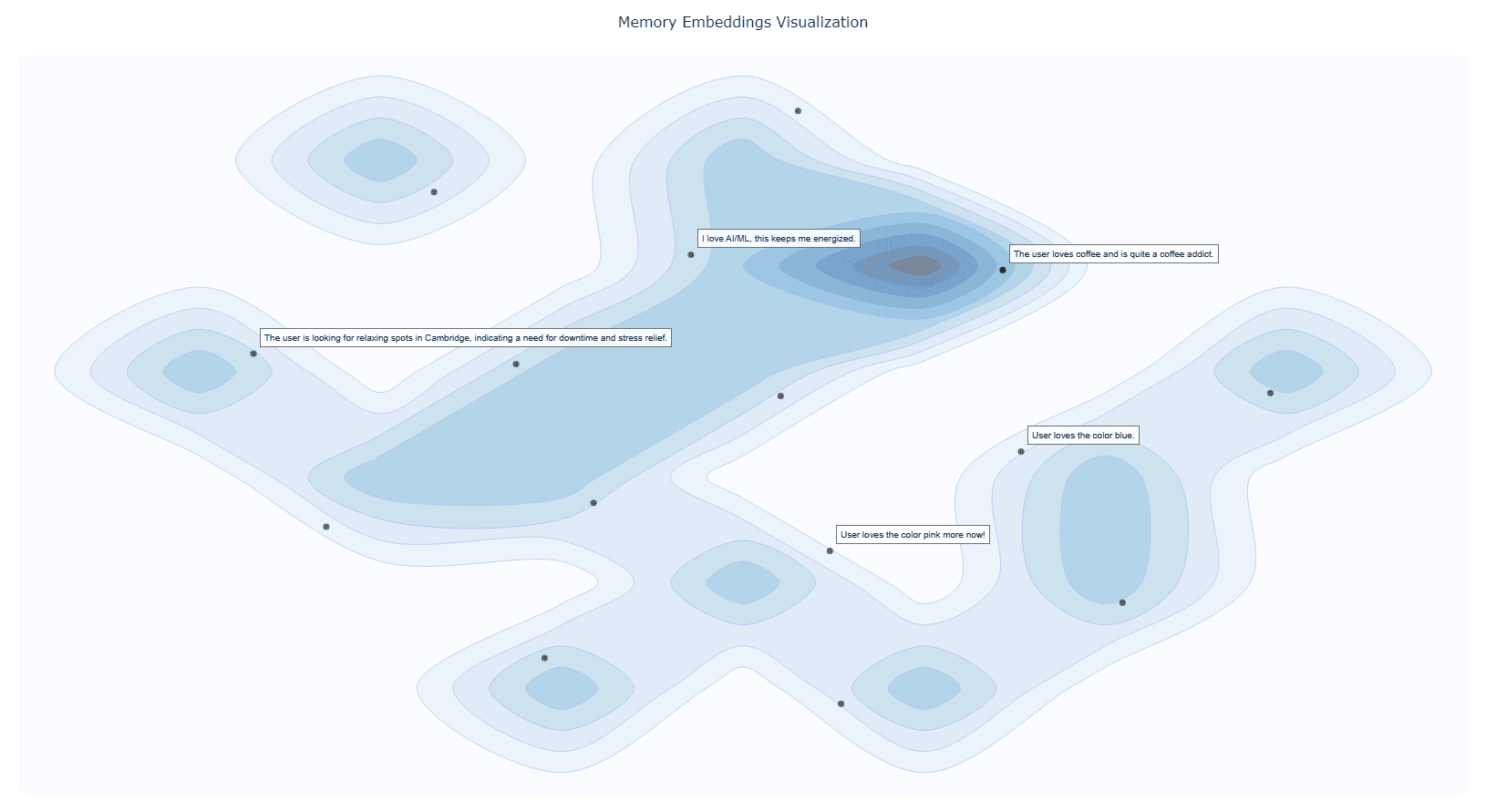
- Visualize Memories:Interactive graph clusters revealing relationships.
- File Import (since v0.1.2):Ingest documents directly into memory.
- Delete Memories (since v0.1.2):Remove unwanted entries.
- Memory for Memories (since v0.1.4):Now we use
resourcesto teach your AI exactly when (and when not) to recall past interactions. - Memory Versioning (since v0.1.4):When memories are updated, we keep the old versions to provide a full history.
Installation
1. Prerequisites
Google API Key
Obtain from Google AI Studio and set as GOOGLE_API_KEY in your environment.
Note that we will only use the
Gemini Embedding APIwith this API key, so it is Entirely Free for you to use!
Setup Google API Key Example
# macOS/Linux
export GOOGLE_API_KEY="<YOUR_API_KEY>"

# Windows (PowerShell)
setx GOOGLE_API_KEY "<YOUR_API_KEY>"
UV Runtime
Required to serve the MCP plugin.
Install UV Runtime
pip install uv
Or install via shell scripts:
# macOS/Linux
curl -LsSf https://astral.sh/uv/install.sh | sh

# Windows (PowerShell)
powershell -ExecutionPolicy ByPass -c "irm https://astral.sh/uv/install.ps1 | iex"
VS Code One-Click Setup
Click the badge below to automatically install and configure Memory-Plus in VS Code:

This will add the following to your settings.json:
For cursor, go to file -> Preferences -> Cursor Settings -> MCP and add the above config.
If you didn’t add the GOOGLE_API_KEY to your secrets / environment variables, you can add it with:
just after the args array with in the memory-plus dictionary.
For Cline add the following to your cline_mcp_settings.json:
For other IDEs it should be mostly similar to the above.
Local Testing and Development
Using MCP Inspector, you can test the memory-plus server locally.
git clone https://github.com/Yuchen20/Memory-Plus.git
cd Memory-Plus
npx @modelcontextprotocol/inspector fastmcp run run .\\memory_plus\\mcp.py
Or If you prefer using this MCP in an actual Chat Session. There is a template chatbot in agent.py.
# Clone the repository
git clone https://github.com/Yuchen20/Memory-Plus.git
cd Memory-Plus

# Install dependencies
pip install uv
uv pip install fast-agent-mcp
uv run fast-agent setup
setup the fastagent.config.yaml and fastagent.secrets.yaml with your own API keys.
# Run the agent
uv run agent_memory.py
RoadMap
- [x] Memory Update
- [x] Improved prompt engineering for memory recording
- [x] Better Visualization of Memory Graph
- [x] File Import
- [ ] Remote backup!
- [ ] Web UI for Memory Management
If you have any feature requests, please feel free to add them by adding a new issue or by adding a new entry in the Feature Request
License
This project is licensed under the Apache License 2.0. See LICENSE for details.
FAQ
1. Why is memory-plus not working?
- Memory-plus has a few dependencies that can be slow to download the first time. It typically takes around 1 minute to fetch everything needed.
- Once dependencies are installed, subsequent usage will be much faster.
- If you experience other issues, please feel free to open a new issue on the repository.
2. How do I use memory-plus in a real chat session?
- Simply add the MCP JSON file to your MCP setup.
- Once added, memory-plus will automatically activate when needed.
Dev Tools Supporting MCP
The following are the main code editors that support the Model Context Protocol. Click the link to visit the official website for more information.







