
Adk Mcp Rag
What is Adk Mcp Rag
adk-mcp-rag is a Retrieval-Augmented Generation (RAG) system that integrates Google’s Agent Development Kit (ADK) with the Qdrant vector database via an MCP server to enhance knowledge retrieval and improve responses from Large Language Models (LLMs).
Use cases
Use cases include building intelligent chatbots that provide accurate answers, creating content generation tools that utilize existing knowledge bases, and developing educational platforms that offer personalized learning experiences through context-aware responses.
How to use
To use adk-mcp-rag, clone the repository, set up a virtual environment, install dependencies, and configure environment variables in a .env file. After setup, you can run the system to retrieve relevant context and generate answers based on that context.
Key features
Key features include advanced semantic search powered by Qdrant, integration with Google’s ADK for LLM capabilities, the use of MCP server for model context management, context augmentation for improved LLM responses, and comprehensive monitoring and logging of system performance.
Where to use
adk-mcp-rag can be used in various fields such as customer support, content generation, educational tools, and any application requiring enhanced information retrieval and natural language processing.
Clients Supporting MCP
The following are the main client software that supports the Model Context Protocol. Click the link to visit the official website for more information.





Overview
What is Adk Mcp Rag
adk-mcp-rag is a Retrieval-Augmented Generation (RAG) system that integrates Google’s Agent Development Kit (ADK) with the Qdrant vector database via an MCP server to enhance knowledge retrieval and improve responses from Large Language Models (LLMs).
Use cases
Use cases include building intelligent chatbots that provide accurate answers, creating content generation tools that utilize existing knowledge bases, and developing educational platforms that offer personalized learning experiences through context-aware responses.
How to use
To use adk-mcp-rag, clone the repository, set up a virtual environment, install dependencies, and configure environment variables in a .env file. After setup, you can run the system to retrieve relevant context and generate answers based on that context.
Key features
Key features include advanced semantic search powered by Qdrant, integration with Google’s ADK for LLM capabilities, the use of MCP server for model context management, context augmentation for improved LLM responses, and comprehensive monitoring and logging of system performance.
Where to use
adk-mcp-rag can be used in various fields such as customer support, content generation, educational tools, and any application requiring enhanced information retrieval and natural language processing.
Clients Supporting MCP
The following are the main client software that supports the Model Context Protocol. Click the link to visit the official website for more information.
Content
RAG Agent with Google ADK and Qdrant MCP server
A Retrieval-Augmented Generation (RAG) system that leverages Google’s Agent Development Kit (ADK) and Qdrant vector database via MCP server.
Table of Contents
Overview
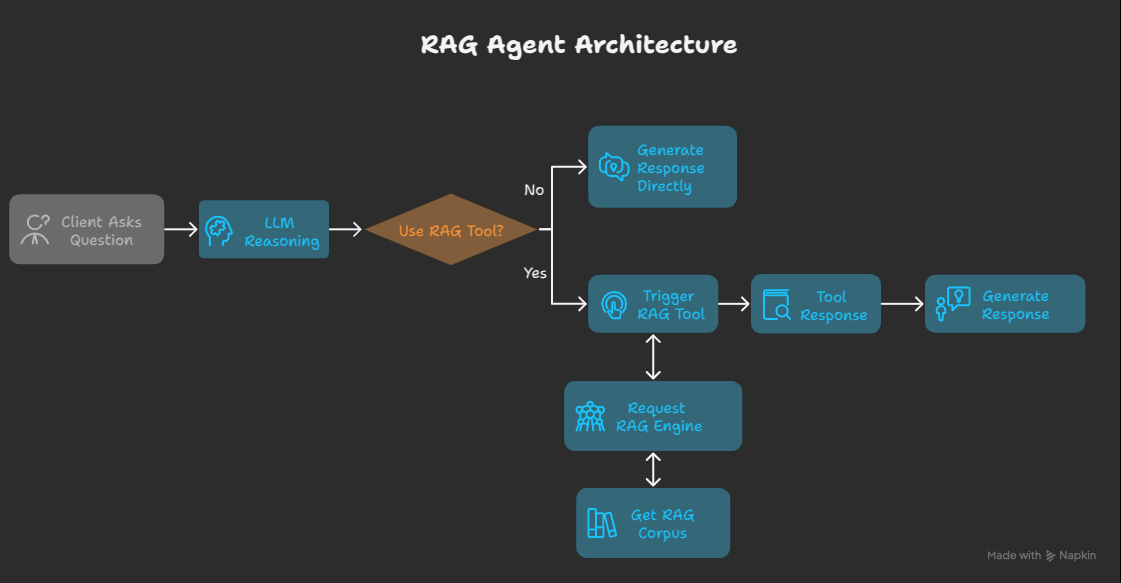
This project implements a Retrieval-Augmented Generation (RAG) system that combines the power of Google’s Agent Development Kit (ADK) with Qdrant vector database (via MCP server) for efficient knowledge retrieval. The system enhances Large Language Model (LLM) responses by retrieving relevant context from a vector database before generating answers.
Architecture
Features
- Advanced Retrieval: Semantic search powered by Qdrant vector database
- Google ADK Integration: Leverages Google’s Agent Development Kit for LLM capabilities
- MCP Server: Model Context Protocol server for Qdrant vector database
- Context Augmentation: Enhances LLM responses with relevant retrieved information
- Monitoring & Logging: Comprehensive tracking of system performance
Installation
Remember to install the uv first
# Clone the repository
git clone https://github.com/khoi03/adk-mcp-rag.git
cd adk-mcp-rag

# Create a virtual environment and install dependencies
uv sync

# Activate the virtual environment
# For macOS/Linux
source .venv/bin/activate
# For Windows
.venv\Scripts\activate

# Add required dependencies via requirement file (In case there are new libs)
uv add -r requirements.txt
Configuration
Environment Variables
Create a .env file in docker directory:
# Change directory into docker
cd docker

# Set up environment variables
cp .env.example .env
# Edit .env with your API keys and configuration
Example .env file:
# -------------------
# Google API keys
# -------------------
GOOGLE_API_KEY=YOUR_VALUE_HERE

# -------------------
# OPENAI API keys
# -------------------
OPENAI_API_KEY=YOUR_VALUE_HERE

# -------------------
# ANTHROPIC API keys
# -------------------
ANTHROPIC_API_KEY=YOUR_VALUE_HERE

# -------------------
# Network names
# -------------------
NETWORK_NAME=mcp-servers

# ----------------------------------
# Parameters for Qdrant MCP Server
# ----------------------------------
QDRANT_CONTAINER_NAME=qdrant-mcp
QDRANT_URL=http://qdrant:6333
QRANT_MCP_SSE=http://localhost:8888/sse
# QDRANT_LOCAL_PATH=/qdrant/db
COLLECTION_NAME=default_collection
QDRANT_EMBEDDING_MODEL=sentence-transformers/all-MiniLM-L6-v2
QDRANT_SEARCH_LIMIT=3
FASTMCP_HOST=0.0.0.0
FASTMCP_PORT=8888
Build Qdrant and Qdrant MCP
Build Qdrant and Qdrant MCP server using Docker Compose after completing the configuration steps:
# Build and start services
docker compose -p qdrant-mcp up --build -d

# Check running services
docker compose ps

# View logs
docker compose logs -f

# Stop and remove services
docker compose -p qdrant-mcp down
You can also access qdrant web UI at http://localhost:6333/dashboard
Usage
Document Ingestion
Push all your needed files into the data directory and run:
python local_vector_store/prepare_corpus_and_data_locally.py
Note: Currently only processes .md and .pdf files. The system will:
- Extract text from the documents
- Split the text into manageable chunks
- Generate embeddings for each chunk
- Store the embeddings in the Qdrant vector database
Basic Usage
To test and run the system with default settings:
python main.py
Built-in ADK-UI
For tracing, testing, and debugging with a UI, run the built-in web interface provided by ADK:
adk web
Project Structure
adk-mcp-rag/
├── assets/                  # Images and static files
├── data/                    # Documents for ingestion
├── docker/                  # Docker configurations
│   ├── .env.example         # Example environment variables
│   ├── Dockerfile.qdrant    # Docker file for qdrant mcp
│   └── docker-compose.yml   # Docker Compose configuration
├── agents/                  # Main code
│   ├── config/prompts.yml   # Store prompts
│   ├── tools/               # Embedding generation
│       ├── mcp_tools.py     # Manage MCP Tools
│       └── prompts.py       # Manage Prompts
│   └── agent/               # Manage agents
├── .gitignore               # Git ignore file
├── main.py                  # Main entry point
├── README.md                # This file
└── requirements.txt         # Python dependencies
Dev Tools Supporting MCP
The following are the main code editors that support the Model Context Protocol. Click the link to visit the official website for more information.







