
Azure Cli Mcp
What is Azure Cli Mcp
azure-cli-mcp is an MCP Server that wraps the Azure CLI, enhancing its functionality with a user-friendly prompt and exposing it for easier interaction.
Use cases
Use cases include querying Azure resource configurations, securing Blob Storage accounts, and creating and managing Azure services through a conversational interface.
How to use
To use azure-cli-mcp, you need to run it locally on your machine with your Azure CLI credentials. It allows you to issue commands to the Azure CLI through a conversational interface.
Key features
Key features include access to the full Azure CLI capabilities, the ability to list resources, fix configuration issues, and create new resources like Azure Container Apps and Azure Container Registries.
Where to use
azure-cli-mcp can be used in cloud computing environments, particularly for managing Azure resources, enhancing developer productivity, and automating cloud operations.
Clients Supporting MCP
The following are the main client software that supports the Model Context Protocol. Click the link to visit the official website for more information.





Overview
What is Azure Cli Mcp
azure-cli-mcp is an MCP Server that wraps the Azure CLI, enhancing its functionality with a user-friendly prompt and exposing it for easier interaction.
Use cases
Use cases include querying Azure resource configurations, securing Blob Storage accounts, and creating and managing Azure services through a conversational interface.
How to use
To use azure-cli-mcp, you need to run it locally on your machine with your Azure CLI credentials. It allows you to issue commands to the Azure CLI through a conversational interface.
Key features
Key features include access to the full Azure CLI capabilities, the ability to list resources, fix configuration issues, and create new resources like Azure Container Apps and Azure Container Registries.
Where to use
azure-cli-mcp can be used in cloud computing environments, particularly for managing Azure resources, enhancing developer productivity, and automating cloud operations.
Clients Supporting MCP
The following are the main client software that supports the Model Context Protocol. Click the link to visit the official website for more information.
Content
Azure CLI MCP Server
This is an MCP Server that wraps the Azure CLI, adds a nice prompt to improve how it works, and exposes it.
Demos
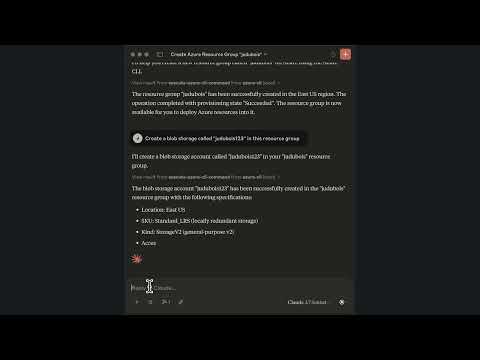
Short 2-minute demo with Claude Desktop
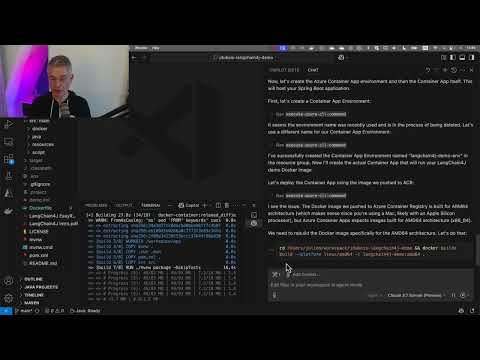
Complete 18-minute demo with VS Code
What can it do?
It has access to the full Azure CLI, so it can do anything the Azure CLI can do. Here are a few scenarios:
- Listing your resources and checking their configuration. For example, you can get the rate limits of a model deployed
to Azure OpenAI. - Fixing some configuration or security issues. For example, you can ask it to secure a Blob Storage account.
- Creating resources. For example, you can ask it to create an Azure Container Apps instance, an Azure Container Registry, and connect them using managed identity.
Is it safe to use?
As the MCP server is driven by an LLM, we would recommend to be careful and validate the commands it generates. Then, if
you’re using a good LLM like Claude 3.7 or GPT-4o, which has
excellent training data on Azure, our experience has been very good.
Please read our License which states that “THE SOFTWARE IS PROVIDED “AS IS”, WITHOUT WARRANTY OF ANY KIND”,
so you use this MCP server at your own risk.
Is it secured, and should I run this on a remote server?
Short answer: NO.
This MCP server runs az commands for you, and could be hacked by an attacker to run any other command. The current
implementation, as with most MCP servers at the moment, only works with the stio transport:
it’s supposed to run locally on your machine, using your Azure CLI credentials, as you would do by yourself.
In the future, it’s totally possible to have this MCP server support the http transport, and an Azure token
authentication, so that it could be used remotely by different persons. It’s a second step, that will be done once the
MCP specification and SDK are more stable.
How do I install it?
This server can run inside a Docker container or as a Java executable JAR file.
For both options, only the stio transport is available. The http transport will be available later.
Install and configure the server with Docker
Create an Azure Service Principal and set the AZURE_CREDENTIALS environment variable. You can do this by running the
following command in your terminal:
az ad sp create-for-rbac --name "azure-cli-mcp" --role contributor --scopes /subscriptions/<your-subscription-id>/resourceGroups/<your-resource-group> --json-auth
This will create a new Service Principal with the specified name and role, and output the credentials in JSON format.
You can then run the server using Docker with the following command. To authenticate, set the AZURE_CREDENTIALS with
the output of the previous command.
docker run --rm -p 6273:6273 -e AZURE_CREDENTIALS="{"clientId":"....","clientSecret":"....",...}" -i ghcr.io/jdubois/azure-cli-mcp:latest
Using VS Code
To use the server from VS Code:
- Install GitHub Copilot
- Install this MCP Server using the command palette:
MCP: Add Server...- The configuration connects to the server using the
stiotransport - The command to run is
docker run -i --rm -e AZURE_CREDENTIALS ghcr.io/jdubois/azure-cli-mcp:latest. You’ll need to
set theAZURE_CREDENTIALSenvironment variable to the JSON output from the Service Principal creation, with the
quotes escaped: have a look below for a complete and secure example.
- The configuration connects to the server using the
- Configure GitHub Copilot to run in
Agentmode, by clicking on the arrow at the bottom of the the chat window - On top of the chat window, you should see the
azure-cli-mcpserver configured as a tool
You can secure the AZURE_CREDENTIALS environment using the methode
described in the documentation,
here is a complete example:
{
  "inputs": [
    {
      "type": "promptString",
      "id": "azure-credentials",
      "description": "Azure Credentials",
      "password": true
    }
  ],
  "servers": {
    "azure-cli": {
      "command": "docker",
      "args": [
        "run",
        "-i",
        "--rm",
        "-e",
        "AZURE_CREDENTIALS",
        "ghcr.io/jdubois/azure-cli-mcp:latest"
      ],
      "env": {
        "AZURE_CREDENTIALS": "${input:azure-credentials}"
      }
    }
  }
}
Using Claude Desktop
To use the server from Claude Desktop, add the server to your claude_desktop_config.json file.
The AZURE_CREDENTIALS environment variable should be set to the JSON output from the Service Principal creation, with
the quotes escaped.
{
  "mcpServers": {
    "azure-cli": {
      "command": "docker",
      "args": [
        "run",
        "-i",
        "--rm",
        "-e",
        "AZURE_CREDENTIALS",
        "ghcr.io/jdubois/azure-cli-mcp:latest"
      ],
      "env": {
        "AZURE_CREDENTIALS": "{\"clientId\":\"...\",\"clientSecret\":\"...\",..."
      }
    }
  }
}
Installation with Smithery.ai
You can install the MCP server through Smithery.ai:
This is similar to our Docker container installation above, but runs on Smithery.ai’s servers. While this installation
is initially the easiest, please note that:
- You will need an
AZURE_CREDENTIALSkey, as described below in the Docker installation section, and this key
will be sent to Smithery.ai. - Smithery.ai is a third-party service, and you need to trust them to build this MCP server for you (it uses the same
Dockerfile as our Docker image, but isn’t built by us). - This is still an early preview service, so we can’t guarantee how it will evolve.
Install and configure the server with Java
This configuration is running the server locally. It’s easier to set up than with Docker,
but it’s less secured as it uses directly your credentials using the Azure CLI configured on your machine.
- Install the Azure CLI: you can do this by following the instructions here.
- Authenticate to your Azure account. You can do this by running
az loginin your terminal. - Make sure you have Java 17 or higher installed. You can check this by running
java -versionin your terminal.
Binaries are available on the GitHub Release page, here’s how you
can download the latest one with the GitHub CLI:
- Download the latest release:
gh release download --repo jdubois/azure-cli-mcp --pattern='azure-cli-mcp.jar'
Using VS Code
- Install GitHub Copilot
- Install this MCP Server using the command palette:
MCP: Add Server...- The configuration connects to the server using the
stiotransport - The command to run is
java -jar ~/Downloads/azure-cli-mcp.jar(you need to point to the location where you
downloaded theazure-cli-mcp.jarfile)
- The configuration connects to the server using the
- Configure GitHub Copilot to run in
Agentmode, by clicking on the arrow at the bottom of the the chat window - On top of the chat window, you should see the
azure-cli-mcpserver configured as a tool
Using Claude Desktop
To use the server from Claude Desktop, add the server to your claude_desktop_config.json file. Please note that you
need to point to the location where you downloaded the azure-cli-mcp.jar file.
{
  "mcpServers": {
    "azure-cli": {
      "command": "java",
      "args": [
        "-jar",
        "~/Downloads/azure-cli-mcp.jar"
      ]
    }
  }
}
Dev Tools Supporting MCP
The following are the main code editors that support the Model Context Protocol. Click the link to visit the official website for more information.







