
Code Reasoning
What is Code Reasoning
Code Reasoning is an enhanced MCP server designed for programming tasks and complex problem-solving, serving as a fork of the Sequential Thinking server.
Use cases
Use cases include multi-step planning, design processes, debugging sessions, and open-ended analysis where complex problems need to be broken down into manageable steps.
How to use
To use Code Reasoning, install it globally with npm, configure it in Claude Desktop by editing the configuration file, and then start Claude Desktop to utilize the enhanced sequential thinking capabilities.
Key features
Key features include a programming focus, improved parameter naming with snake_case, enhanced prompting for clearer guidance, enforcement of best practices by limiting steps to 20, and seamless integration with Claude Desktop.
Where to use
Code Reasoning is ideal for software development, debugging, algorithm design, and any programming-related tasks that require structured thinking.
Clients Supporting MCP
The following are the main client software that supports the Model Context Protocol. Click the link to visit the official website for more information.





Overview
What is Code Reasoning
Code Reasoning is an enhanced MCP server designed for programming tasks and complex problem-solving, serving as a fork of the Sequential Thinking server.
Use cases
Use cases include multi-step planning, design processes, debugging sessions, and open-ended analysis where complex problems need to be broken down into manageable steps.
How to use
To use Code Reasoning, install it globally with npm, configure it in Claude Desktop by editing the configuration file, and then start Claude Desktop to utilize the enhanced sequential thinking capabilities.
Key features
Key features include a programming focus, improved parameter naming with snake_case, enhanced prompting for clearer guidance, enforcement of best practices by limiting steps to 20, and seamless integration with Claude Desktop.
Where to use
Code Reasoning is ideal for software development, debugging, algorithm design, and any programming-related tasks that require structured thinking.
Clients Supporting MCP
The following are the main client software that supports the Model Context Protocol. Click the link to visit the official website for more information.
Content
Code Reasoning MCP Server
A Model Context Protocol (MCP) server that enhances Claude’s ability to solve complex programming tasks through structured, step-by-step thinking.


Quick Installation
-
Configure Claude Desktop by editing:
- macOS:
~/Library/Application Support/Claude/claude_desktop_config.json - Windows:
%APPDATA%\Claude\claude_desktop_config.json - Linux:
~/.config/Claude/claude_desktop_config.json
{ "mcpServers": { "code-reasoning": { "command": "npx", "args": [ "-y", "@mettamatt/code-reasoning" ] } } } - macOS:
-
Configure VS Code:
{
  "mcp": {
    "servers": {
      "code-reasoning": {
        "command": "npx",
        "args": [
          "-y",
          "@mettamatt/code-reasoning"
        ]
      }
    }
  }
}
Usage
-
To trigger this MCP, append this to your chat messages:
Use sequential thinking to reason about this. -
Use ready-to-go prompts that trigger Code-Reasoning:
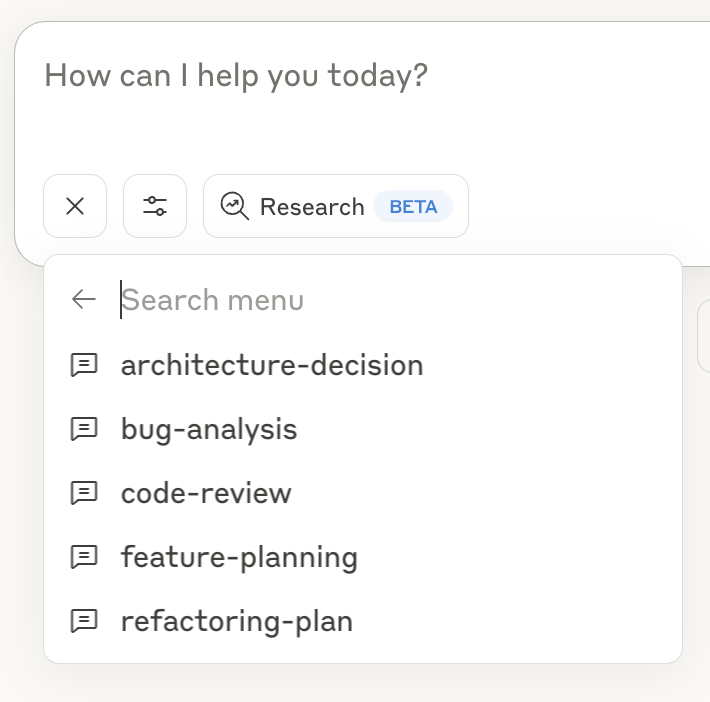
- Click the “+” icon in the Claude Desktop chat window, or in Claude Code type
/helpto see the specific commands. - Select “Add from Code Reasoning” from the available tools
- Choose a prompt template and fill in the required information
- Submit the form to add the prompt to your chat message and hit return
See the Prompts Guide for details on using the prompt templates.
Command Line Options
--debug: Enable detailed logging--helpor-h: Show help information
Key Features
- Programming Focus: Optimized for coding tasks and problem-solving
- Structured Thinking: Break down complex problems into manageable steps
- Thought Branching: Explore multiple solution paths in parallel
- Thought Revision: Refine earlier reasoning as understanding improves
- Safety Limits: Automatically stops after 20 thought steps to prevent loops
- Ready-to-Use Prompts: Pre-defined templates for common development tasks
Documentation
Detailed documentation available in the docs directory:
- Usage Examples: Examples of sequential thinking with the MCP server
- Configuration Guide: All configuration options for the MCP server
- Prompts Guide: Using and customizing prompts with the MCP server
- Testing Framework: Testing information
Project Structure
├── index.ts                  # Entry point
├── src/                      # Implementation source files
└── test/                     # Testing framework
Prompt Evaluation
The Code Reasoning MCP Server includes a prompt evaluation system that assesses Claude’s ability to follow the code reasoning prompts. This system allows:
- Testing different prompt variations against scenario problems
- Verifying parameter format adherence
- Scoring solution quality
To use the prompt evaluation system, run:
npm run eval
Prompt Comparison and Development
Significant effort went into developing the optimal prompt for the Code Reasoning server. The current implementation uses the HYBRID_DESIGN prompt, which emerged as the winner from our evaluation process.
We compared four different prompt designs:
| Prompt Design | Description |
|---|---|
| SEQUENTIAL | The original sequential thinking prompt design |
| DEFAULT | The baseline prompt previously used in the server |
| CODE_REASONING_0_30 | An experimental variant focusing on code-specific reasoning |
| HYBRID_DESIGN | A refined design incorporating the best elements of other approaches |
Our evaluation across seven diverse programming scenarios showed that HYBRID_DESIGN outperformed other prompts:
| Scenario | HYBRID_DESIGN | CODE_REASONING_0_30 | DEFAULT | SEQUENTIAL |
|---|---|---|---|---|
| Algorithm Selection | 89% | 82% | 92% | 88% |
| Bug Identification | 92% | 91% | 88% | 94% |
| Multi-Stage Implementation | 87% | 67% | 82% | 87% |
| System Design Analysis | 87% | 87% | 83% | 82% |
| Code Debugging Task | 96% | 87% | 91% | 93% |
| Compiler Optimization | 83% | 78% | 72% | 78% |
| Cache Strategy | 87% | 88% | 89% | 87% |
| Average | 89% | 83% | 85% | 87% |
The HYBRID_DESIGN prompt demonstrates the highest average solution quality (89%) and the most consistent performance across all scenarios, with no scores below 80%. It also produces the most thoughts. The src/server.ts file has been updated to use this optimal prompt design.
Personally, I think the biggest improvement was adding this to the end of the prompt: "✍️ End each thought by asking: “What am I missing or need to reconsider?”
See Testing Framework for more details on the prompt evaluation system.
License
This project is licensed under the MIT License. See the LICENSE file for details.
Dev Tools Supporting MCP
The following are the main code editors that support the Model Context Protocol. Click the link to visit the official website for more information.







