
Hivemind
What is Hivemind
Hivemind is a knowledge management system designed to provide AI coding tools with memory and constraints for libraries, patterns, and development standards, ensuring consistency in coding practices.
Use cases
Use cases for Hivemind include validating project adherence to established coding standards, collaborating on development guidelines, and providing consistent architecture recommendations for new projects.
How to use
To use Hivemind, developers can set, retrieve, search, and validate facts against their project’s coding standards and preferences through the Model Context Protocol (MCP). This helps maintain architectural consistency across projects.
Key features
Key features of Hivemind include centralized management of development guidelines, automatic validation of coding standards, and support for preferred libraries and architectural patterns, enhancing the reliability of AI coding tools.
Where to use
Hivemind can be used in software development environments, particularly in projects that require strict adherence to coding standards and patterns, such as web development with frameworks like NextJS.
Clients Supporting MCP
The following are the main client software that supports the Model Context Protocol. Click the link to visit the official website for more information.





Overview
What is Hivemind
Hivemind is a knowledge management system designed to provide AI coding tools with memory and constraints for libraries, patterns, and development standards, ensuring consistency in coding practices.
Use cases
Use cases for Hivemind include validating project adherence to established coding standards, collaborating on development guidelines, and providing consistent architecture recommendations for new projects.
How to use
To use Hivemind, developers can set, retrieve, search, and validate facts against their project’s coding standards and preferences through the Model Context Protocol (MCP). This helps maintain architectural consistency across projects.
Key features
Key features of Hivemind include centralized management of development guidelines, automatic validation of coding standards, and support for preferred libraries and architectural patterns, enhancing the reliability of AI coding tools.
Where to use
Hivemind can be used in software development environments, particularly in projects that require strict adherence to coding standards and patterns, such as web development with frameworks like NextJS.
Clients Supporting MCP
The following are the main client software that supports the Model Context Protocol. Click the link to visit the official website for more information.
Content
HiveMind
A fact management system that provides automatic coding tools with consistent guidance about libraries, patterns, and development standards.
Why HiveMind?
AI coding tools make the same mistakes again and again. If you’ve tried building with NextJS 15 they frequently mess up AppRouter; using ShadCN chances are they’ve used the wrong command- npx install shadcn-ui instead of npx install shadcn. They also don’t make good or consistent architecture and design decisions.
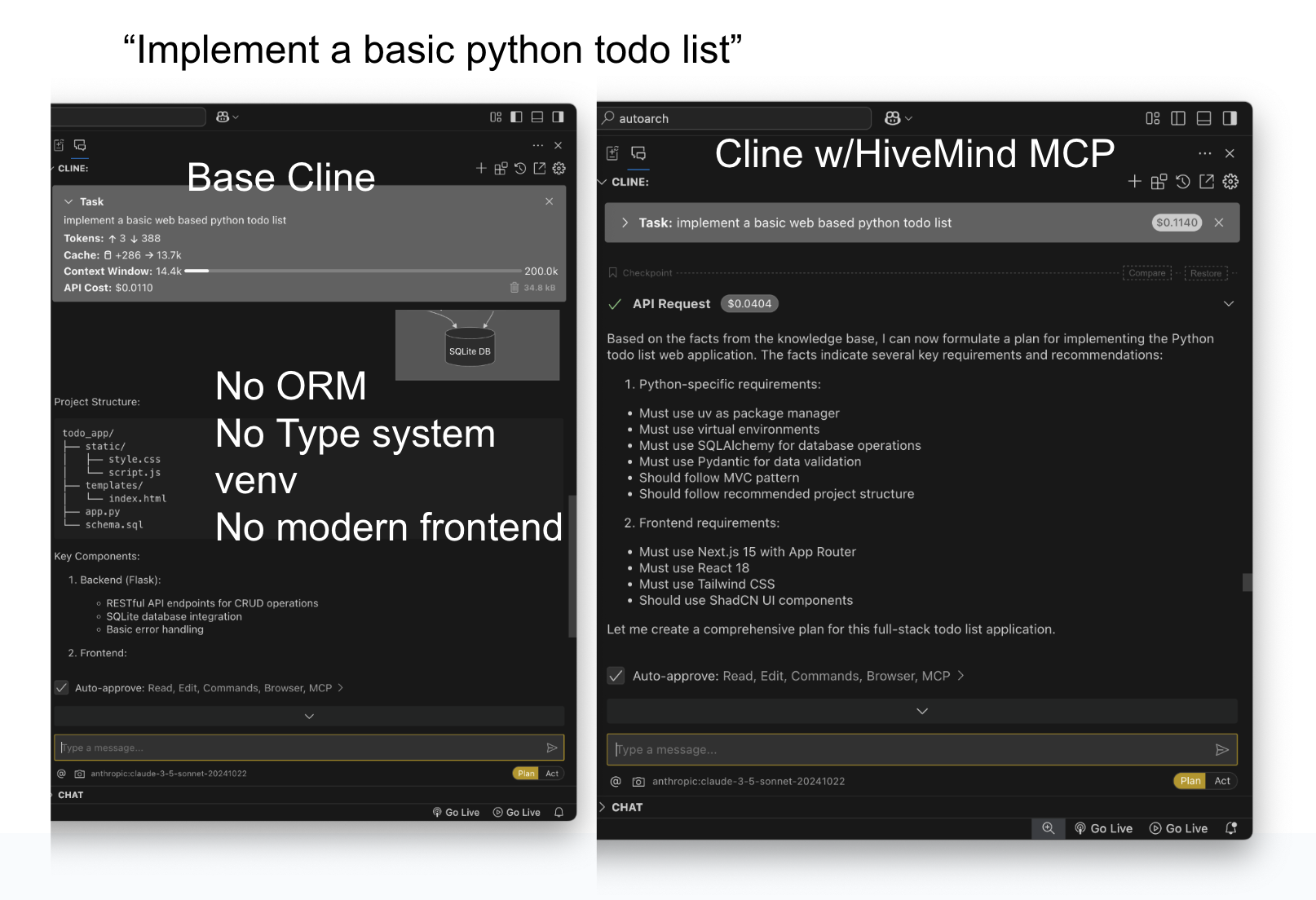
When working with automatic coding tools like Cline in Cursor, developers often find themselves repeatedly providing the same guidance about coding standards, preferred libraries, and architectural patterns. HiveMind solves this by creating a centralized system for managing and enforcing these development guidelines through the Model Context Protocol (MCP).
This repository is a prototype that demonstrates an MCP server that allows facts to be set, retrieved, searched, and validated against. The goal is to help autonomous coding tools maintain consistency with your project’s standards and preferences.
See an example validation report that demonstrates how HiveMind validates projects against established facts.
Hivemind in Action


Features
- Facts Management: Store and retrieve development decisions, guidelines, and standards
- Automated Validation: Validate code changes against established criteria
- Flexible Categories: Support for multiple development aspects (frontend, backend, security, etc.)
- Configurable Rules: Adjustable strictness levels for different types of guidelines
Getting Started
Prerequisites
- Node.js
- SQLite
- MCP SDK
Installation
-
Clone the repository
-
Install dependencies:
cd facts-server npm install -
Build the project:
npm run build -
Configure the MCP service:
 "hivemind": {
   "command": "node",
   "args": [
     "<YOUR PATH>/hivemind/facts-server/build/index.js"
   ],
   "env": {},
   "disabled": false,
   "autoApprove": []
 }
Configuration
The .clinerules file configures how facts are managed:
- Automatic saving of development decisions
- Validation of proposals against existing facts
- Strictness levels for different fact types
- Category mappings for various development aspects
Usage
Running the Facts Server
cd facts-server
npm start
Interacting with Facts
The facts server provides the following tools:
- Create/update facts
- Search facts by type, strictness, and version
- Validate content against fact criteria
- Retrieve existing facts
Technical Details
System Architecture
graph TB
    subgraph "System Architecture"
        MCP[Model Context Protocol]

        subgraph "Facts Management"
            FS[Facts Server]
            DB[(SQLite DB)]
            VS[Vector Search]
        end

        subgraph "Validation Layer"
            VP[Validation Processor]
            RC[Rules Configuration]
        end

        IDE[Development Environment]
    end

    classDef default fill:#f9f9f9,stroke:#333,stroke-width:2px;
    classDef highlight fill:#e1f5fe,stroke:#0288d1,stroke-width:2px;
    class MCP,FS highlight
Request Flow
%%{init: {'sequence': {'width': 400, 'actorMargin': 30, 'messageMargin': 15, 'boxMargin': 10, 'fontSize': 11, 'actorFontSize': 11, 'noteFontSize': 11, 'messageFontSize': 11}}}%%
sequenceDiagram
    participant IDE as Dev Env
    participant MCP as MCP
    participant FS as Facts
    participant DB as DB
    participant VP as Validator

    IDE->>MCP: Dev Request
    MCP->>FS: Query Facts
    FS->>DB: Fetch Rules
    DB-->>FS: Rules Data
    FS->>VP: Validate
    VP-->>FS: Result
    FS-->>MCP: Facts & Valid.
    MCP-->>IDE: Standards
The architecture diagram shows the core components of HiveMind, centered around the Model Context Protocol (MCP) which integrates with your development environment. The Facts Server manages development guidelines and standards using a SQLite database with vector search capabilities.
Project Structure
HiveMind/
├── facts-server/        # MCP server for facts management
│   ├── src/            # TypeScript source files
│   ├── prisma/         # Database schema and migrations
│   └── build/          # Compiled JavaScript output
└── .clinerules         # Configuration for facts integration
Technology Stack
- TypeScript
- Prisma (SQLite)
- MCP SDK
- Vector extensions for similarity search
Development Scripts
npm run build- Build the TypeScript codenpm run dev- Run with debugging enablednpm start- Start the facts server
Contributing
Contributions are welcome! Feel free to submit issues, feature requests, or pull requests.
Contact
You can reach me on:
License
This project is licensed under the MIT License - see the LICENSE file for details.
Dev Tools Supporting MCP
The following are the main code editors that support the Model Context Protocol. Click the link to visit the official website for more information.







