
Http 4 Mcp
What is Http 4 Mcp
HTTP-4-MCP is a middleware server that transforms standard HTTP APIs into MCP (Model Control Protocol) interfaces without the need for coding. It provides an easy-to-use configuration tool for quick setup.
Use cases
Use cases for HTTP-4-MCP include transforming existing web services into MCP tools, enabling real-time data streaming for applications, and simplifying the integration of different systems that rely on HTTP APIs.
How to use
To use HTTP-4-MCP, clone the repository from GitHub or Gitee, navigate to the project directory, and install the necessary dependencies using the uv package manager. After installation, you can configure your HTTP API through a visual interface.
Key features
Key features include one-click conversion from HTTP to MCP, JSON-based configuration, SSE support for real-time data streaming, a drag-and-drop visual configuration interface, hot reload for instant updates, complete monitoring with logging, and built-in security features.
Where to use
HTTP-4-MCP can be used in various fields such as IoT applications, data streaming services, and any environment where HTTP APIs need to be converted to MCP interfaces for better control and management.
Clients Supporting MCP
The following are the main client software that supports the Model Context Protocol. Click the link to visit the official website for more information.





Overview
What is Http 4 Mcp
HTTP-4-MCP is a middleware server that transforms standard HTTP APIs into MCP (Model Control Protocol) interfaces without the need for coding. It provides an easy-to-use configuration tool for quick setup.
Use cases
Use cases for HTTP-4-MCP include transforming existing web services into MCP tools, enabling real-time data streaming for applications, and simplifying the integration of different systems that rely on HTTP APIs.
How to use
To use HTTP-4-MCP, clone the repository from GitHub or Gitee, navigate to the project directory, and install the necessary dependencies using the uv package manager. After installation, you can configure your HTTP API through a visual interface.
Key features
Key features include one-click conversion from HTTP to MCP, JSON-based configuration, SSE support for real-time data streaming, a drag-and-drop visual configuration interface, hot reload for instant updates, complete monitoring with logging, and built-in security features.
Where to use
HTTP-4-MCP can be used in various fields such as IoT applications, data streaming services, and any environment where HTTP APIs need to be converted to MCP interfaces for better control and management.
Clients Supporting MCP
The following are the main client software that supports the Model Context Protocol. Click the link to visit the official website for more information.
Content
🚀 HTTP-4-MCP Middleware Server


🌟 Introduction
HTTP-4-MCP is a powerful middleware server that magically transforms regular HTTP interfaces into MCP (Model Control Protocol) interfaces. With simple configuration, your HTTP API becomes an MCP tool instantly!
✨ Key Features
- 🔄 HTTP to MCP: One-click conversion of HTTP APIs to MCP interfaces
- 📝 JSON Configuration: Simple and intuitive configuration
- 🌊 SSE Support: Real-time data streaming
- 🎨 Visual Configuration: Drag-and-drop interface for API configuration
- 🔥 Hot Reload: Instant configuration updates without restart
- 📊 Complete Monitoring: Detailed logging and error tracking
- 🛡️ Secure & Reliable: Built-in error handling and parameter validation
👨💻 Author Information


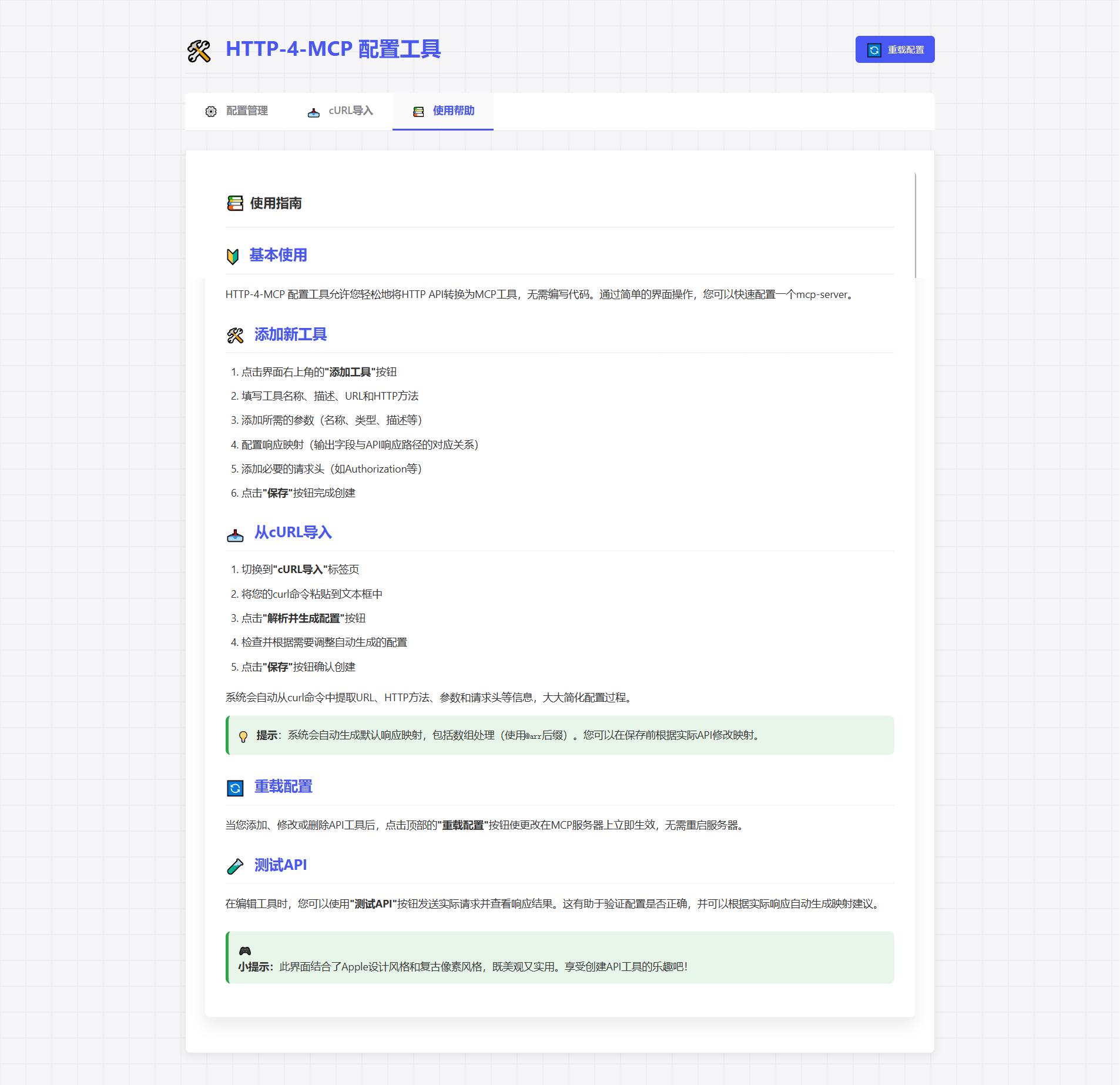
📸 System Demo
🖥️ Intuitive Visual Configuration Interface
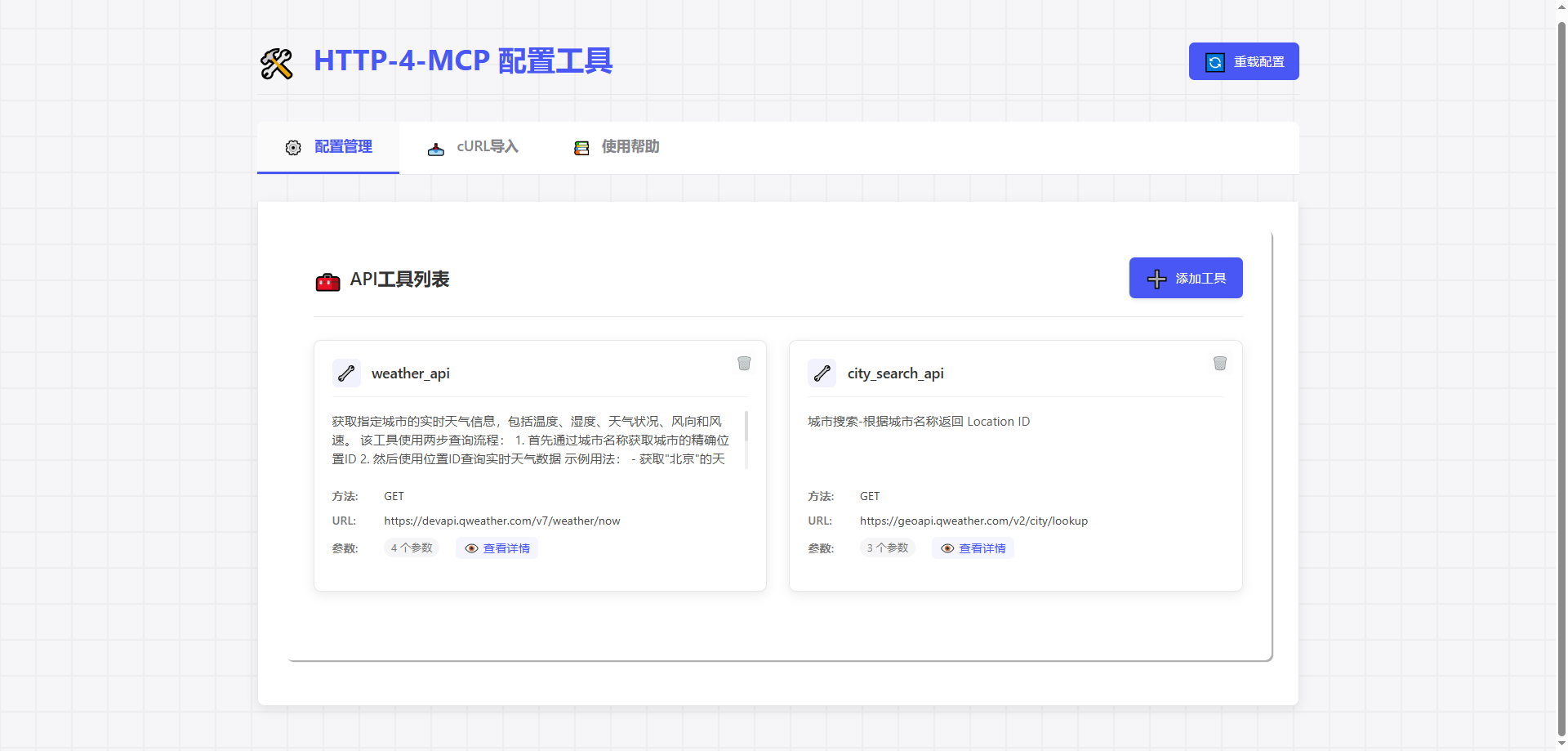
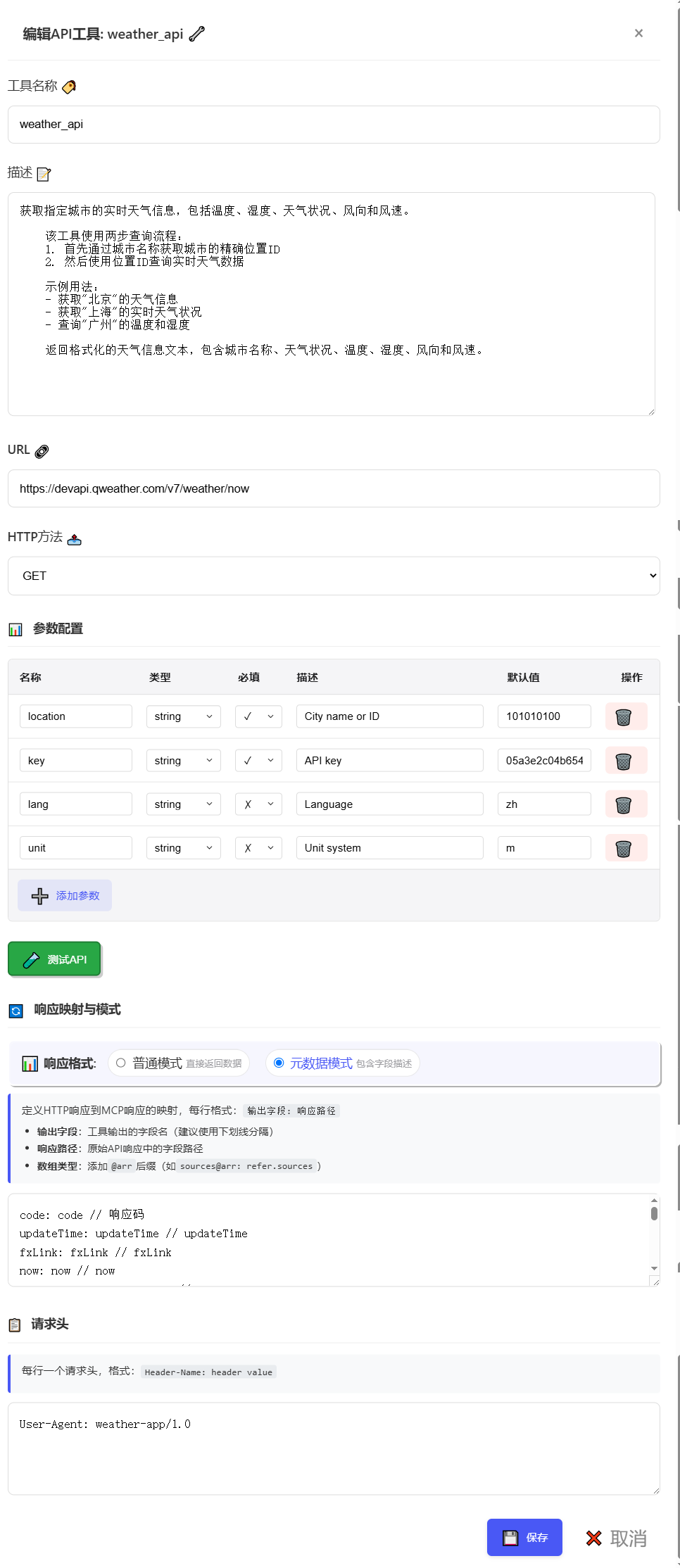
🔄 Powerful API Conversion
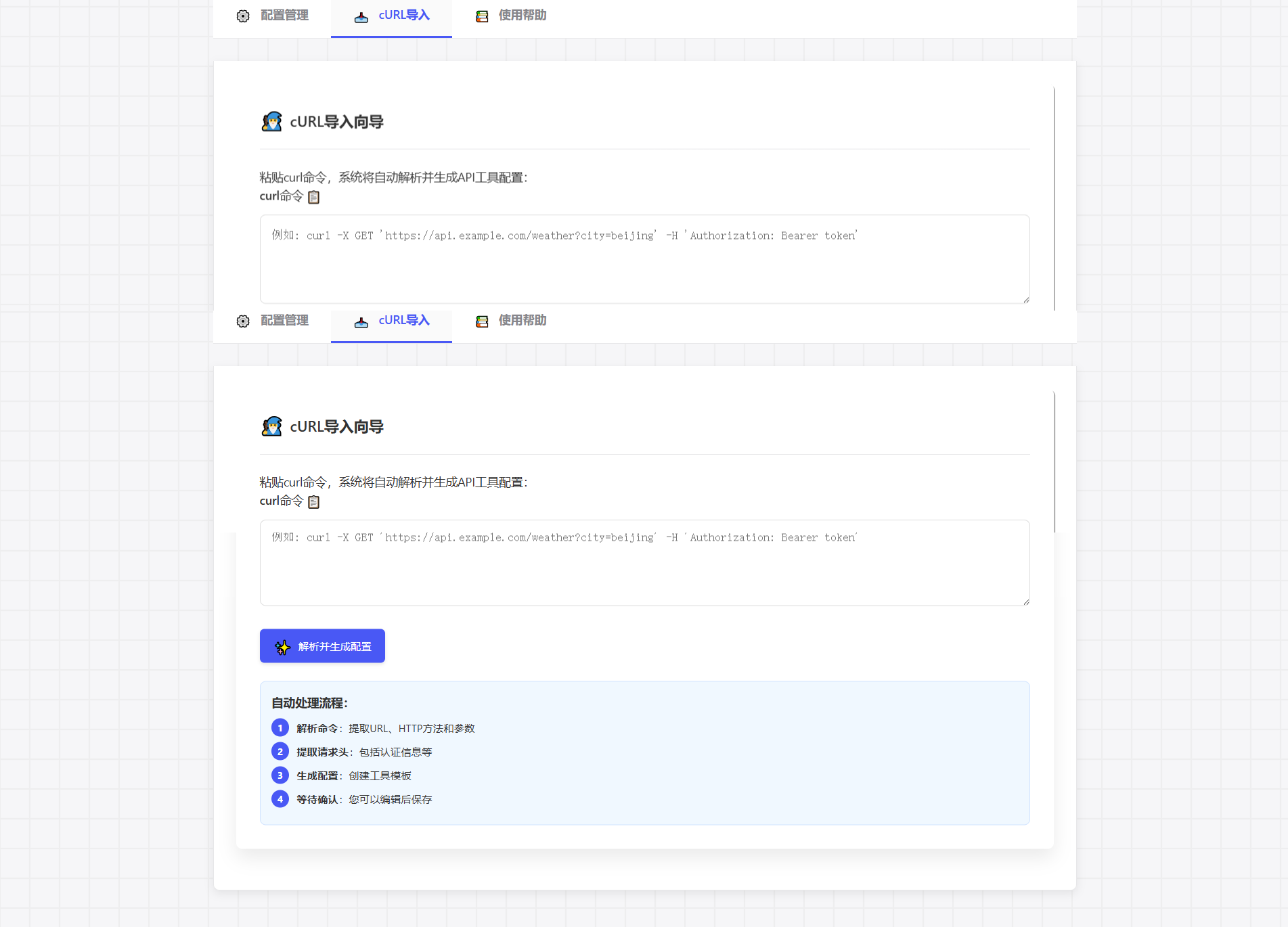
📊 cURL Import Support
🚀 Tool Description
🚀 Quick Start
📦 Installation
# Clone repository
git clone https://gitee.com/tght1211/http-for-mcp-server.git
# or git clone https://github.com/tght1211/http-for-mcp-server.git

cd http-for-mcp-server

# Install dependencies (recommended using uv package manager)
uv venv
uv pip install -r requirements.txt
🎮 Start Service
# Activate virtual environment
.venv/Scripts/activate  # Windows
source .venv/bin/activate  # Linux/Mac

# Start main server
uv run run.py

# Start configuration UI (optional)
uv run run_config_ui.py
🎯 Usage Guide
1️⃣ Configure API
Method 1: 🎨 Visual Configuration (Recommended)
- Visit
http://localhost:8002 - Click “Add New Interface”
- Fill in configuration parameters
- Save and apply instantly!
Method 2: 📝 JSON Configuration
{
  "tools": [
    {
      "name": "weather_api",
      "description": "Get real-time weather information for a specified city, including temperature, humidity, weather conditions, wind direction, and wind speed.\n    \n    This tool uses a two-step query process:\n    1. First, get the precise location ID through city name\n    2. Then, query real-time weather data using the location ID\n    \n    Example usage:\n    - Get weather information for \"Beijing\"\n    - Get real-time weather conditions for \"Shanghai\"\n    - Query temperature and humidity for \"Guangzhou\"\n    \n    Returns formatted weather information text, including city name, weather conditions, temperature, humidity, wind direction, and wind speed.",
      "url": "https://devapi.qweather.com/v7/weather/now",
      "method": "GET",
      "params": {
        "location": {
          "type": "string",
          "desc": "City name or ID",
          "required": true,
          "default": "101010100"
        },
        "key": {
          "type": "string",
          "desc": "API key",
          "required": true,
          "default": "05a3e2c04b65416e912088b76a7a487e"
        },
        "lang": {
          "type": "string",
          "desc": "Language",
          "required": false,
          "default": "zh"
        },
        "unit": {
          "type": "string",
          "desc": "Unit system",
          "required": false,
          "default": "m"
        }
      },
      "headers": {
        "User-Agent": "weather-app/1.0"
      },
      "response": {
        "code": {
          "path": "code",
          "desc": "Response status code"
        },
        "updateTime": {
          "path": "updateTime",
          "desc": "Data update time"
        },
        "fxLink": {
          "path": "fxLink",
          "desc": "Detailed weather information link"
        },
        "now": {
          "path": "now",
          "desc": "Real-time weather data object"
        },
        "now_obsTime": {
          "path": "now.obsTime",
          "desc": "Actual observation time"
        },
        "now_temp": {
          "path": "now.temp",
          "desc": "Current temperature (Celsius)"
        },
        "now_feelsLike": {
          "path": "now.feelsLike",
          "desc": "Feels like temperature (Celsius)"
        },
        "now_icon": {
          "path": "now.icon",
          "desc": "Weather icon code"
        },
        "now_text": {
          "path": "now.text",
          "desc": "Weather phenomenon text description"
        },
        "now_wind360": {
          "path": "now.wind360",
          "desc": "Wind direction 360-degree angle"
        },
        "now_windDir": {
          "path": "now.windDir",
          "desc": "Wind direction description"
        },
        "now_windScale": {
          "path": "now.windScale",
          "desc": "Wind scale"
        },
        "now_windSpeed": {
          "path": "now.windSpeed",
          "desc": "Wind speed (km/h)"
        },
        "now_humidity": {
          "path": "now.humidity",
          "desc": "Relative humidity percentage"
        },
        "now_precip": {
          "path": "now.precip",
          "desc": "Precipitation (mm)"
        },
        "now_pressure": {
          "path": "now.pressure",
          "desc": "Atmospheric pressure (hPa)"
        },
        "now_vis": {
          "path": "now.vis",
          "desc": "Visibility (km)"
        },
        "now_cloud": {
          "path": "now.cloud",
          "desc": "Cloud coverage percentage"
        },
        "now_dew": {
          "path": "now.dew",
          "desc": "Dew point temperature (Celsius)"
        }
      },
      "response_mode": "metadata"
    }
  ]
}
2️⃣ Connect to MCP
# SSE connection URL
ws_url = "http://localhost:8000/mcp/sse"
🛠️ Project Structure
📦 http-for-mcp-server
 ┣ 📂 config/            # Configuration files
 ┣ 📂 demo/             # Example code
 ┣ 📂 static/           # Static resources
 ┣ 📜 mcp_server.py     # Main server
 ┣ 📜 config_ui.py      # Configuration UI
 ┣ 📜 run.py           # Startup script
 ┗ 📜 requirements.txt  # Dependencies
📚 Configuration Reference
🔧 Global Configuration
| Configuration | Description | Default |
|---|---|---|
| 🌐 host | Server address | “0.0.0.0” |
| 🔌 port | Server port | 8000 |
| 🐛 debug | Debug mode | false |
| 📝 log_level | Log level | “info” |
🎉 Special Features
🔄 cURL Import
Paste cURL command directly, automatically generate configuration:
curl -X GET 'https://api.example.com/weather?city=beijing'
🎨 Pixel Art Interface
- 🎮 Game-like configuration experience
- 🎯 Drag-and-drop parameter setting
- 📊 Real-time request test
- 🔄 Automatically generate configuration
🤝 Contribution Guide
- 🍴 Fork this repository
- 🔧 Create feature branch
- 📝 Submit changes
- 🚀 Push branch
- 📬 Submit Pull Request
📞 Get Help
- 📧 Submit Issue
- 💬 Join Discussion Group
- 📚 View Wiki
📄 Open Source License
This project uses the MIT license - see LICENSE file
Dev Tools Supporting MCP
The following are the main code editors that support the Model Context Protocol. Click the link to visit the official website for more information.







