
Image Tools Mcp
What is Image Tools Mcp
image-tools-mcp is a Model Context Protocol (MCP) service designed for retrieving image dimensions and compressing images from both URL and local file sources.
Use cases
Use cases include retrieving dimensions of images for web optimization, compressing images for faster loading times, and converting images to different formats for compatibility across platforms.
How to use
To use image-tools-mcp, integrate it with an MCP client such as Claude Desktop. After configuring the client with the necessary API key and server details, you can retrieve image dimensions or compress images by sending appropriate commands.
Key features
Key features include retrieving image dimensions from URLs and local files, compressing images using the TinyPNG API, converting images to different formats (webp, jpeg/jpg, png), and returning detailed information such as width, height, type, MIME type, and compression status.
Where to use
image-tools-mcp can be used in various fields including web development, graphic design, and any application that requires image processing and optimization.
Clients Supporting MCP
The following are the main client software that supports the Model Context Protocol. Click the link to visit the official website for more information.





Overview
What is Image Tools Mcp
image-tools-mcp is a Model Context Protocol (MCP) service designed for retrieving image dimensions and compressing images from both URL and local file sources.
Use cases
Use cases include retrieving dimensions of images for web optimization, compressing images for faster loading times, and converting images to different formats for compatibility across platforms.
How to use
To use image-tools-mcp, integrate it with an MCP client such as Claude Desktop. After configuring the client with the necessary API key and server details, you can retrieve image dimensions or compress images by sending appropriate commands.
Key features
Key features include retrieving image dimensions from URLs and local files, compressing images using the TinyPNG API, converting images to different formats (webp, jpeg/jpg, png), and returning detailed information such as width, height, type, MIME type, and compression status.
Where to use
image-tools-mcp can be used in various fields including web development, graphic design, and any application that requires image processing and optimization.
Clients Supporting MCP
The following are the main client software that supports the Model Context Protocol. Click the link to visit the official website for more information.
Content
Image Tools MCP
A Model Context Protocol (MCP) service for retrieving image dimensions and compressing images, supporting both URL and local file sources.
Features
- Retrieve image dimensions from URLs
- Get image dimensions from local files
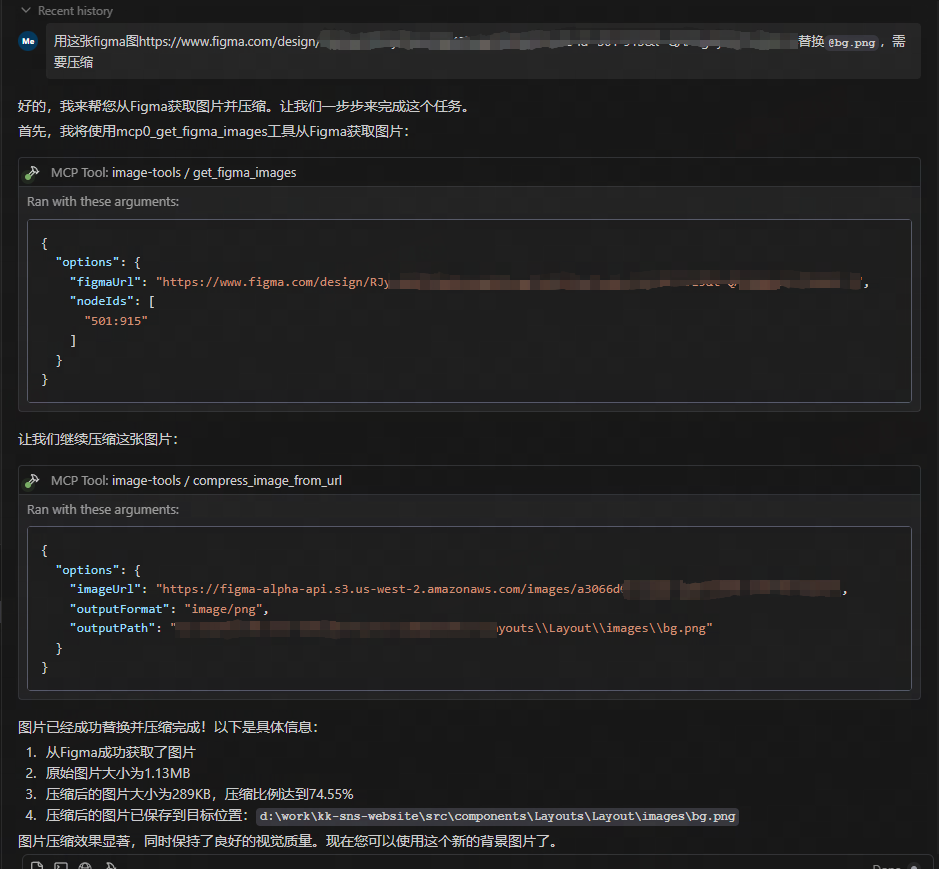
- Compress images from URLs using TinyPNG API
- Compress local images using TinyPNG API
- Convert images to different formats (webp, jpeg/jpg, png)
- Returns width, height, type, MIME type, and compression information
Example Results
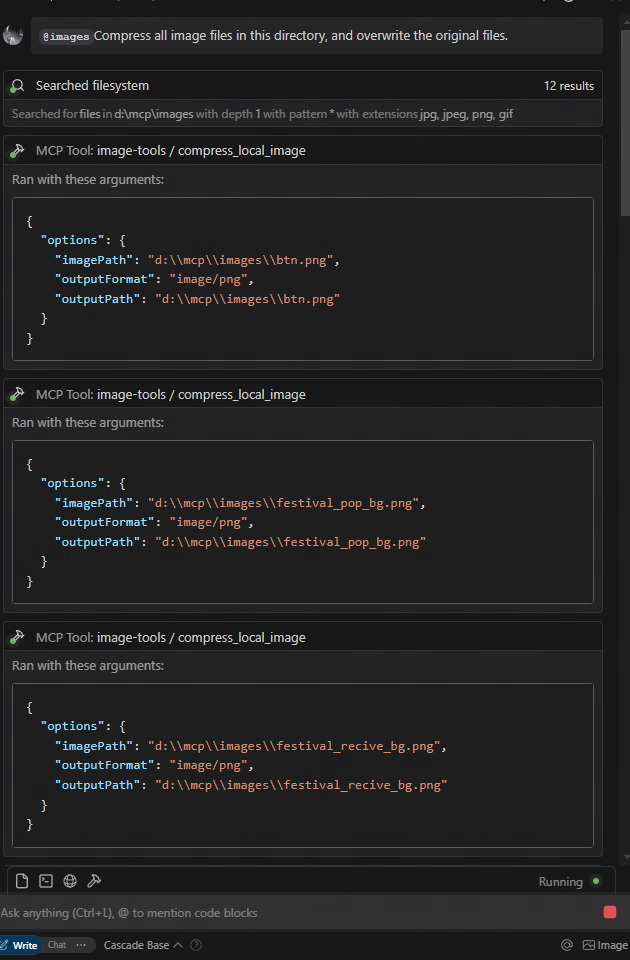
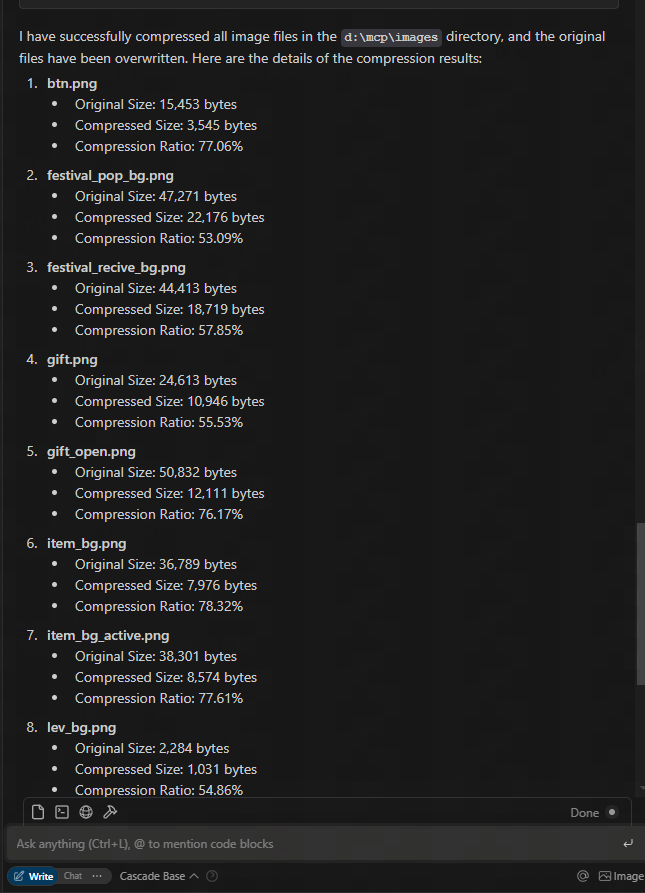
download from figma url and compress
Usage
Using as an MCP Service
This service provides five tool functions:
get_image_size- Get dimensions of remote imagesget_local_image_size- Get dimensions of local imagescompress_image_from_url- Compress remote images using TinyPNG APIcompress_local_image- Compress local images using TinyPNG APIfigma- Fetch image links from Figma API and compress them using TinyPNG API
Client Integration
To use this MCP service, you need to connect to it from an MCP client. Here are examples of how to integrate with different clients:
Using with Claude Desktop
- Install Claude Desktop from claude.ai/download
- Get TinyPNG API key: Visit TinyPNG and get your API key
- Configure Claude Desktop to use this MCP server by editing the configuration file:
{
  "mcpServers": {
    "image-tools": {
      "command": "npx",
      "args": [
        "image-tools-mcp"
      ],
      "env": {
        "TINIFY_API_KEY": "<YOUR_TINIFY_API_KEY>",
        "FIGMA_API_TOKEN": "<YOUR_FIGMA_API_TOKEN>"
      }
    }
  }
}- Restart Claude Desktop
- Ask Claude to get image dimensions: “Can you tell me the dimensions of this image: https://example.com/image.jpg”
- Ask Claude to compress an image: “Can you compress this image: https://example.com/image.jpg”
- Ask Claude to compress a local image: “Can you compress this image: D:/path/to/image.png”
- Ask Claude to compress a local image folder: “Can you compress this folder: D:/imageFolder”
- Ask Claude to fetch image links from Figma API: “Can you fetch image links from Figma API: https://www.figma.com/file/XXXXXXX”
Using with MCP Client Library
import { McpClient } from "@modelcontextprotocol/client";

// Initialize the client
const client = new McpClient({
  transport: "stdio" // or other transport options
});

// Connect to the server
await client.connect();

// Get image dimensions from URL
const urlResult = await client.callTool("get_image_size", {
  options: {
    imageUrl: "https://example.com/image.jpg"
  }
});
console.log(JSON.parse(urlResult.content[0].text));
// Output: { width: 800, height: 600, type: "jpg", mime: "image/jpeg" }

// Get image dimensions from local file
const localResult = await client.callTool("get_local_image_size", {
  options: {
    imagePath: "D:/path/to/image.png"
  }
});
console.log(JSON.parse(localResult.content[0].text));
// Output: { width: 1024, height: 768, type: "png", mime: "image/png", path: "D:/path/to/image.png" }

// Compress image from URL
const compressUrlResult = await client.callTool("compress_image_from_url", {
  options: {
    imageUrl: "https://example.com/image.jpg",
    outputFormat: "webp" // Optional: convert to webp, jpeg/jpg, or png
  }
});
console.log(JSON.parse(compressUrlResult.content[0].text));
// Output: { originalSize: 102400, compressedSize: 51200, compressionRatio: "50.00%", tempFilePath: "/tmp/compressed_1615456789.webp", format: "webp" }

// Compress local image
const compressLocalResult = await client.callTool("compress_local_image", {
  options: {
    imagePath: "D:/path/to/image.png",
    outputPath: "D:/path/to/compressed.webp", // Optional
    outputFormat: "image/webp" // Optional: convert to image/webp, image/jpeg, or image/png
  }
});
console.log(JSON.parse(compressLocalResult.content[0].text));
// Output: { originalSize: 102400, compressedSize: 51200, compressionRatio: "50.00%", outputPath: "D:/path/to/compressed.webp", format: "webp" }

// Fetch image links from Figma API

const figmaResult = await client.callTool("figma", {
  options: {
    figmaUrl: "https://www.figma.com/file/XXXXXXX"
  }
});
console.log(JSON.parse(figmaResult.content[0].text));
// Output: { imageLinks: ["https://example.com/image1.jpg", "https://example.com/image2.jpg"] }

### Tool Schemas

#### get_image_size

```typescript
{
  options: {
    imageUrl: string // URL of the image to retrieve dimensions for
  }
}
get_local_image_size
{
  options: {
    imagePath: string; // Absolute path to the local image file
  }
}
compress_image_from_url
{
  options: {
    imageUrl: string // URL of the image to compress
    outputFormat?: "image/webp" | "image/jpeg" | "image/jpg" | "image/png" // Optional output format
  }
}
compress_local_image
{
  options: {
    imagePath: string // Absolute path to the local image file
    outputPath?: string // Optional absolute path for the compressed output image
    outputFormat?: "image/webp" | "image/jpeg" | "image/jpg" | "image/png" // Optional output format
  }
}
figma
{
  options: {
    figmaUrl: string; // URL of the Figma file to fetch image links from
  }
}
Changelog
- 2025-05-12: Updated Figma API to support additional parameters, including 2x image scaling.
Technical Implementation
This project is built on the following libraries:
- probe-image-size - For image dimension detection
- tinify - For image compression via the TinyPNG API
- figma-api - For fetching image links from Figma API
Environment Variables
TINIFY_API_KEY- Required for image compression functionality. Get your API key from TinyPNG- When not provided, the compression tools (
compress_image_from_urlandcompress_local_image) will not be registered
- When not provided, the compression tools (
FIGMA_API_TOKEN- Required for fetching image links from Figma API. Get your API token from Figma- When not provided, the Figma tool (
figma) will not be registered
- When not provided, the Figma tool (
Note: The basic image dimension tools (get_image_size and get_local_image_size) are always available regardless of API keys.
License
MIT
Dev Tools Supporting MCP
The following are the main code editors that support the Model Context Protocol. Click the link to visit the official website for more information.







