
Ks Mcp Server
What is Ks Mcp Server
ks-mcp-server is a KubeSphere MCP Server designed to manage resources within KubeSphere. It is divided into four main modules: Workspace Management, Cluster Management, User and Roles, and Extensions Center.
Use cases
Use cases for ks-mcp-server include managing user roles and permissions in a Kubernetes cluster, overseeing multiple workspaces, and integrating additional extensions to enhance KubeSphere’s capabilities.
How to use
To use ks-mcp-server, you need to build the binary using Go, create a ksconfig file to access KubeSphere, and configure the MCP server in Claude Desktop. You can run it either by standard input/output or by setting up a server-sent events (SSE) server.
Key features
Key features of ks-mcp-server include modular architecture for managing workspaces, clusters, users, and roles, as well as the ability to extend functionalities through the Extensions Center.
Where to use
ks-mcp-server can be used in cloud environments, DevOps practices, and Kubernetes management, particularly for organizations utilizing KubeSphere for container orchestration.
Clients Supporting MCP
The following are the main client software that supports the Model Context Protocol. Click the link to visit the official website for more information.





Overview
What is Ks Mcp Server
ks-mcp-server is a KubeSphere MCP Server designed to manage resources within KubeSphere. It is divided into four main modules: Workspace Management, Cluster Management, User and Roles, and Extensions Center.
Use cases
Use cases for ks-mcp-server include managing user roles and permissions in a Kubernetes cluster, overseeing multiple workspaces, and integrating additional extensions to enhance KubeSphere’s capabilities.
How to use
To use ks-mcp-server, you need to build the binary using Go, create a ksconfig file to access KubeSphere, and configure the MCP server in Claude Desktop. You can run it either by standard input/output or by setting up a server-sent events (SSE) server.
Key features
Key features of ks-mcp-server include modular architecture for managing workspaces, clusters, users, and roles, as well as the ability to extend functionalities through the Extensions Center.
Where to use
ks-mcp-server can be used in cloud environments, DevOps practices, and Kubernetes management, particularly for organizations utilizing KubeSphere for container orchestration.
Clients Supporting MCP
The following are the main client software that supports the Model Context Protocol. Click the link to visit the official website for more information.
Content
KubeSphere MCP Server
The KubeSphere MCP Server is a Model Context Protocol(MCP) server that provides integration with KubeSphere APIs, enabling to get resources from KubeSphere. Divided into four tools modules: Workspace Management, Cluster Management, User and Roles, Extensions Center.
Prerequisites
You must have a KubeSphere cluster. contains: Access Address, Username, Password.
Installation
Generate KSConfig
The format is similar to kubeconfig. This configuration contains HTTP connector information. The default context for KubeSphere is kubesphere, which can be modified via the environment variable KUBESPHERE_CONTEXT.
apiVersion: v1
clusters:
- cluster:
    certificate-authority-data: <CA file>
    server: <Server Address>
  name: kubesphere
contexts:
- context:
    cluster: kubesphere
    user: admin
  name: kubesphere
current-context: kubesphere
kind: Config
preferences: {}
users:
- name: admin
  user:
    username: <KubeSphere Username>
    password: <KubeSphere Password>
<CA file>: Optional. Fill in the CA certificate in base64-encoded format when KubeSphere is accessed via HTTPS.
<Server Address>: Required Must be an HTTPS address. (If using HTTP, enter any HTTPS address here, then modify via the parameter --ks-apiserver http://xxx)
<KubeSphere Username>: Required The user for the KubeSphere cluster.
<KubeSphere Password>: Required The password for the KubeSphere cluster user.
Get ks-mcp-server binary
you can run command go build -o ks-mcp-server cmd/main.go or download from (github releases)[https://github.com/kubesphere/ks-mcp-server/releases]
and then move it to $PATH.
Configuration MCP Server in AI Agent
Claude Desktop
- According to Claude Desktop
should change the MCP Configuration. like:
{
  "mcpServers": {
    "KubeSphere": {
      "args": [
        "stdio",
        "--ksconfig",
        "<ksconfig file absolute path>",
        "--ks-apiserver",
        "<KubeSphere Address>"
      ],
      "command": "ks-mcp-server"
    }
  }
}
<ksconfig file absolute path>: Required The absolute path of the ksconfig file.
<KubeSphere Address>: Optional (but required for HTTP access) The access address of the KubeSphere cluster, supporting either the ks-console or ks-apiserver service address (e.g., http://172.10.0.1:30880).
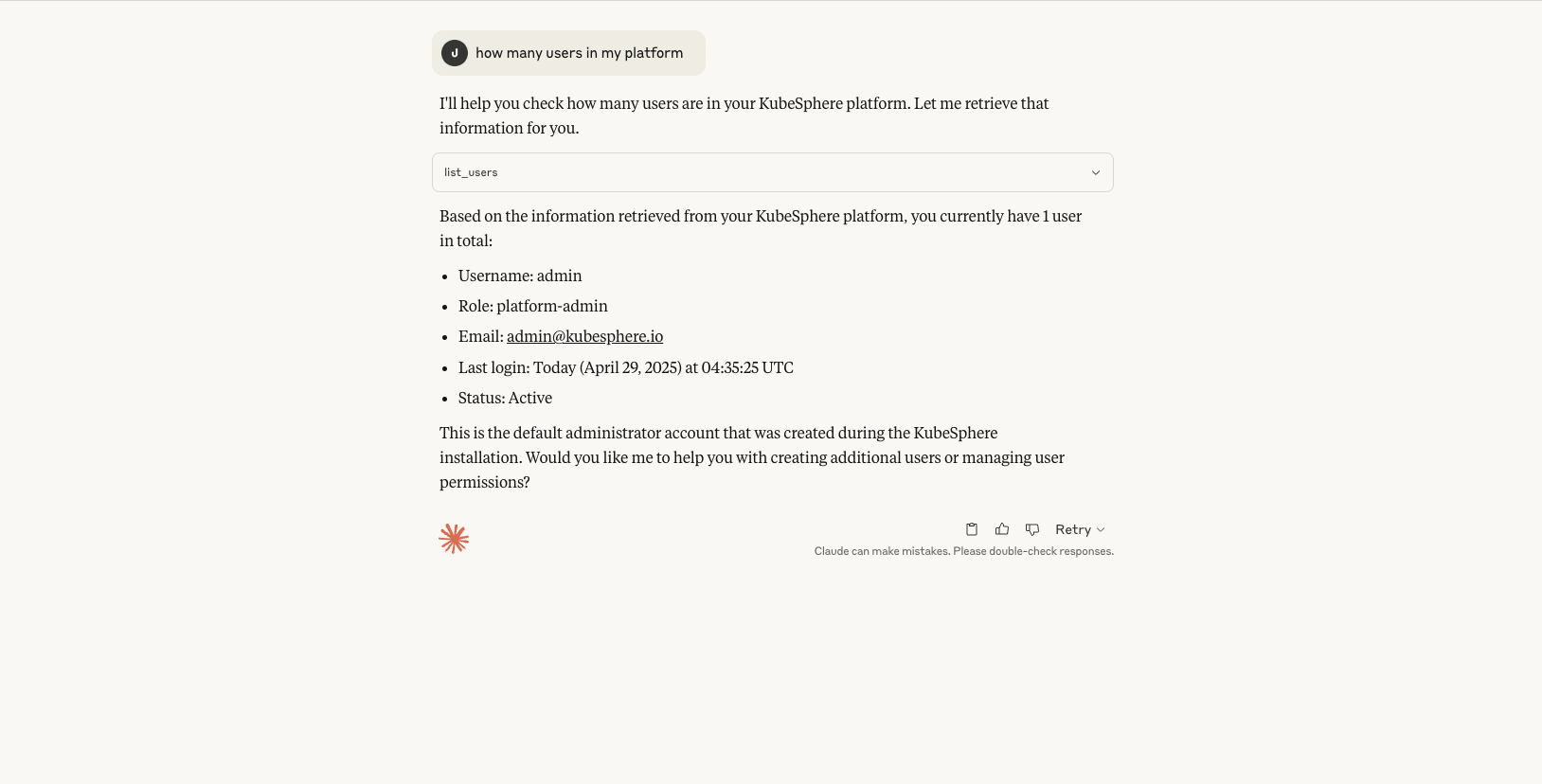
- chat with mcp server
Cursor
- According to Curosr
should change the MCP Configuration. like:
{
  "mcpServers": {
    "KubeSphere": {
      "args": [
        "stdio",
        "--ksconfig",
        "<ksconfig file absolute path>",
        "--ks-apiserver",
        "<KubeSphere Address>"
      ],
      "command": "ks-mcp-server"
    }
  }
}
<ksconfig file absolute path>: Required The absolute path of the ksconfig file.
<KubeSphere Address>: Optional (but required for HTTP access) The access address of the KubeSphere cluster, supporting either the ks-console or ks-apiserver service address (e.g., http://172.10.0.1:30880).
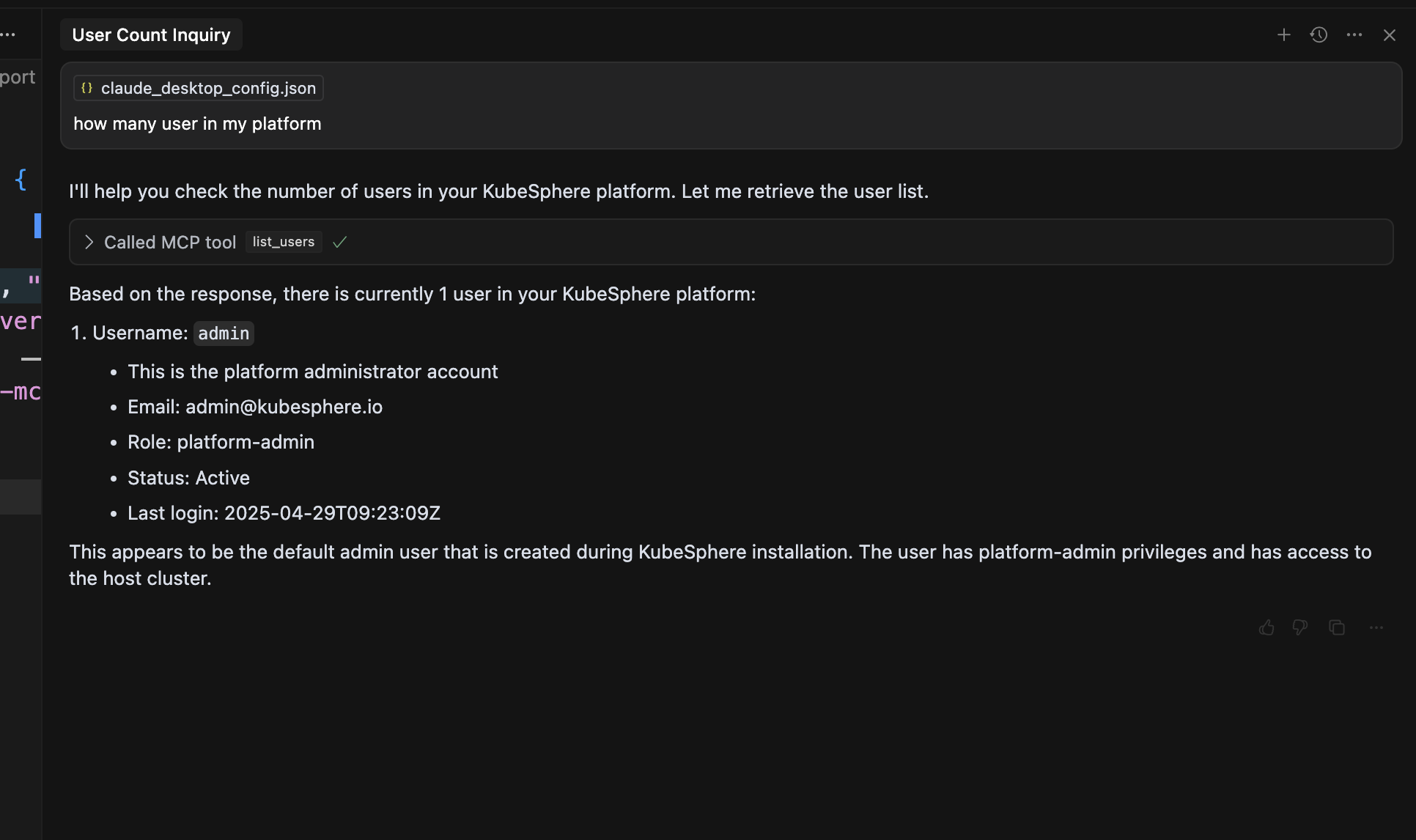
- chat with mcp server
Dev Tools Supporting MCP
The following are the main code editors that support the Model Context Protocol. Click the link to visit the official website for more information.







