
Mcp Korea Tourism Api
What is Mcp Korea Tourism Api
The mcp-korea-tourism-api is a Model Context Protocol (MCP) server that provides tools for accessing the Korea Tourism API, allowing AI assistants to offer comprehensive information about South Korean tourism.
Use cases
Use cases include helping travelers find local attractions, providing event information based on user preferences, and enhancing travel planning with detailed descriptions of accommodations and dining options.
How to use
To use the mcp-korea-tourism-api, developers can integrate it into their AI applications by utilizing the provided API endpoints to fetch data related to tourist attractions, events, and accommodations in Korea.
Key features
Key features include comprehensive search capabilities, rich details about tourist spots, location-aware services, timely information on events, and multilingual support for various languages including English and Chinese.
Where to use
The mcp-korea-tourism-api can be used in travel applications, AI assistants, tourism websites, and any platform that aims to provide information about South Korean tourism.
Clients Supporting MCP
The following are the main client software that supports the Model Context Protocol. Click the link to visit the official website for more information.





Overview
What is Mcp Korea Tourism Api
The mcp-korea-tourism-api is a Model Context Protocol (MCP) server that provides tools for accessing the Korea Tourism API, allowing AI assistants to offer comprehensive information about South Korean tourism.
Use cases
Use cases include helping travelers find local attractions, providing event information based on user preferences, and enhancing travel planning with detailed descriptions of accommodations and dining options.
How to use
To use the mcp-korea-tourism-api, developers can integrate it into their AI applications by utilizing the provided API endpoints to fetch data related to tourist attractions, events, and accommodations in Korea.
Key features
Key features include comprehensive search capabilities, rich details about tourist spots, location-aware services, timely information on events, and multilingual support for various languages including English and Chinese.
Where to use
The mcp-korea-tourism-api can be used in travel applications, AI assistants, tourism websites, and any platform that aims to provide information about South Korean tourism.
Clients Supporting MCP
The following are the main client software that supports the Model Context Protocol. Click the link to visit the official website for more information.
Content
Korea Tourism API MCP Server ✈️



Unlock the wonders of South Korean tourism directly within your AI assistant! This project provides a Model Context Protocol (MCP) server powered by the official Korea Tourism Organization (KTO) API. Equip your AI with the ability to discover vibrant festivals, serene temples, delicious restaurants, comfortable accommodations, and much more across Korea.
Links:
- PyPI Package: https://pypi.org/project/mcp-korea-tourism-api/
- GitHub Repository: https://github.com/harimkang/mcp-korea-tourism-api
- Releases: https://github.com/harimkang/mcp-korea-tourism-api/releases
✨ Features
- Comprehensive Search: Find tourist spots, cultural sites, events, food, lodging, and shopping via keywords, area, or location.
- Rich Details: Access descriptions, operating hours, admission fees, photos, addresses, and contact information.
- Location-Aware: Discover attractions near specific GPS coordinates.
- Timely Information: Find festivals and events based on date ranges.
- Multilingual Support: Get information in various languages supported by the KTO API (including English).
- Supported Languages: English, Japanese, Simplified Chinese, Traditional Chinese, Russian, Spanese, German, French
- Efficient & Resilient:
- Response Caching: Uses time-to-live (TTL) caching to store results and reduce redundant API calls, improving speed.
- Rate Limiting: Respects API usage limits to prevent errors.
- Automatic Retries: Automatically retries requests in case of temporary network or server issues.
- MCP Standard: Seamlessly integrates with AI assistants supporting the Model Context Protocol.
⚠️ Prerequisites
Before you begin, you must obtain an API key from the Korea Tourism Organization (KTO) Data Portal.
- Visit the KTO Data Portal (or the specific portal for the tourism API if available).
- Register and request an API key for the “TourAPI” services (you might need to look for services providing information like
areaBasedList,searchKeyword,detailCommon, etc.). - Keep your Service Key (API Key) safe. It will be required during installation or runtime.
You need to apply for the API below to make a request for each language.
- English: https://www.data.go.kr/data/15101753/openapi.do
- Japanese: https://www.data.go.kr/data/15101760/openapi.do
- Simplified Chinese: https://www.data.go.kr/data/15101764/openapi.do
- Traditional Chinese: https://www.data.go.kr/data/15101769/openapi.do
- Russian: https://www.data.go.kr/data/15101831/openapi.do
- Spanese: https://www.data.go.kr/data/15101811/openapi.do
- German: https://www.data.go.kr/data/15101805/openapi.do
- French: https://www.data.go.kr/data/15101808/openapi.do
🚀 Installation & Running
You can run this MCP server using either uv (a fast Python package installer and runner) or Docker.
Installing via Smithery
To install Korea Tourism API MCP Server for Claude Desktop automatically via Smithery:
npx -y @smithery/cli install @harimkang/mcp-korea-tourism-api --client claude
Option 1: Using uv (Recommended for local development)
-
Clone the repository:
git clone https://github.com/harimkang/mcp-korea-tourism-api.git cd mcp-korea-tourism-api -
Set the API Key Environment Variable:
Replace"YOUR_KTO_API_KEY"with the actual key you obtained.# On macOS/Linux export KOREA_TOURISM_API_KEY="YOUR_KTO_API_KEY" # On Windows (Command Prompt) # set KOREA_TOURISM_API_KEY="YOUR_KTO_API_KEY" # On Windows (PowerShell) # $env:KOREA_TOURISM_API_KEY="YOUR_KTO_API_KEY"Note: For persistent storage, add this line to your shell’s configuration file (e.g.,
.zshrc,.bashrc, or use system environment variable settings). -
Install dependencies and run the server:
This command usesuvto install dependencies based onuv.lock(if available) orpyproject.tomland then runs the server module.uv run -m mcp_tourism.serverThe server will start and listen for MCP requests via standard input/output (stdio).
Option 2: Using Docker (Recommended for isolated environment/deployment)
-
Clone the repository:
git clone https://github.com/harimkang/mcp-korea-tourism-api.git cd mcp-korea-tourism-api -
Build the Docker Image:
Replace"YOUR_KTO_API_KEY"with the actual key you obtained. This command builds the image using the providedDockerfile, passing the API key securely as a build argument.>>> docker build -t mcp-korea-tourism-api . [+] Building 2.7s (13/13) FINISHED docker:desktop-linux => [internal] load build definition from Dockerfile 0.0s => => transferring dockerfile: 1.46kB 0.0s => resolve image config for docker-image://docker.io/docker/dockerfile:1 0.9s => CACHED docker-image://docker.io/docker/dockerfile:1@sha256:4c68376a702446fc3c79af22de146a148b 0.0s => [internal] load metadata for docker.io/library/python:3.12-slim 0.7s => [internal] load .dockerignore 0.0s => => transferring context: 864B 0.0s => [1/6] FROM docker.io/library/python:3.12-slim@sha256:85824326bc4ae27a1abb5bc0dd9e08847aa5fe73 0.0s => [internal] load build context 0.0s => => transferring context: 7.06kB 0.0s => CACHED [2/6] RUN pip install --no-cache-dir uv 0.0s => CACHED [3/6] WORKDIR /app 0.0s => CACHED [4/6] COPY pyproject.toml uv.lock ./ 0.0s => [5/6] RUN uv sync --frozen 0.8s => [6/6] COPY . . 0.0s => exporting to image 0.1s => => exporting layers 0.1s => => writing image sha256:d7d074e85a66a257d00bad4043ea0f5ba8acf6b7c6ef26560c6904bf3ec4d5ff 0.0s => => naming to docker.io/library/mcp-korea-tourism 0.0s >>> docker images REPOSITORY TAG IMAGE ID CREATED SIZE mcp-korea-tourism latest d7d074e85a66 12 seconds ago 215MB-t mcp-korea-tourism-api: Tags the built image with the namemcp-korea-tourism-api..: Specifies the current directory as the build context.
-
Run the Docker Container:
You can run the container in interactive mode for testing or detached mode for background operation.-
Interactive Mode (for manual testing):
docker run --rm -it -e KOREA_TOURISM_API_KEY="YOUR_KTO_API_KEY" mcp-korea-tourism-api--rm: Automatically removes the container when it exits.-it: Runs in interactive mode, attaching your terminal to the container’s stdio.-e KOREA_TOURISM_API_KEY=...: Sets the API key environment variable at runtime (alternative to build-arg).
-
Detached Mode (for background):
docker run --name tourism-mcp -d -e KOREA_TOURISM_API_KEY="YOUR_KTO_API_KEY" mcp-korea-tourism-api--name tourism-mcp: Assigns a name to the container.-d: Runs the container in detached (background) mode.- You can view logs using
docker logs tourism-mcp.
-
🛠️ Integrating with Cursor
To use this MCP server within Cursor:
-
Ensure the Docker container is runnable: Follow the Docker installation steps above to build the image (
mcp-korea-tourism-api). You don’t need to manually run the container; Cursor will do that. -
Locate your
mcp.jsonfile: This file configures MCP tools for Cursor. You can usually find it via Cursor’s settings or potentially in a path like~/.cursor/mcp.jsonor similar. -
Add or Update the MCP Configuration: Add the following JSON object to the list within your
mcp.jsonfile. If you already have an entry for this tool, update itscommand. Replace"YOUR_KTO_API_KEY"with your actual key.
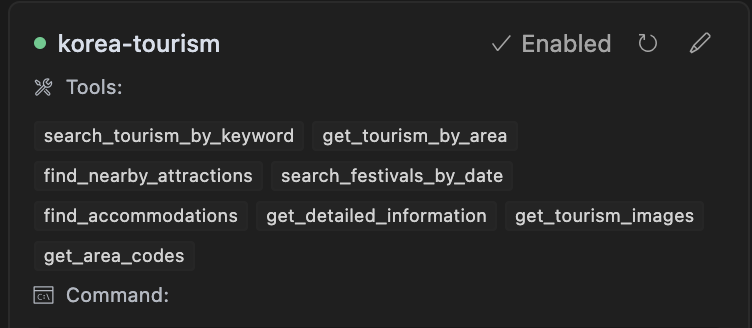
{
  "mcpServers": {
    "korea-tourism": {
      "command": "docker",
      "args": [
        "run",
        "--rm",
        "-i",
        "-e",
        "KOREA_TOURISM_API_KEY=YOUR_KTO_API_KEY",
        "mcp-korea-tourism-api"
      ]
    }
  }
}
OR Use uv [local directory]
{ "mcpServers": { "korea-tourism": { "command": "uv", "args": [ "--directory", "{LOCAL_PATH}/mcp-korea-tourism-api", "run", "-m", "mcp_tourism.server" ], "env": { "KOREA_TOURISM_API_KEY": "YOUR_KTO_API_KEY" } } } } -
Save
mcp.json. -
Restart Cursor or Reload MCP Tools: Cursor should now detect the tool and use Docker to run it when needed.
🛠️ MCP Tools Provided
This server exposes the following tools for AI assistants:
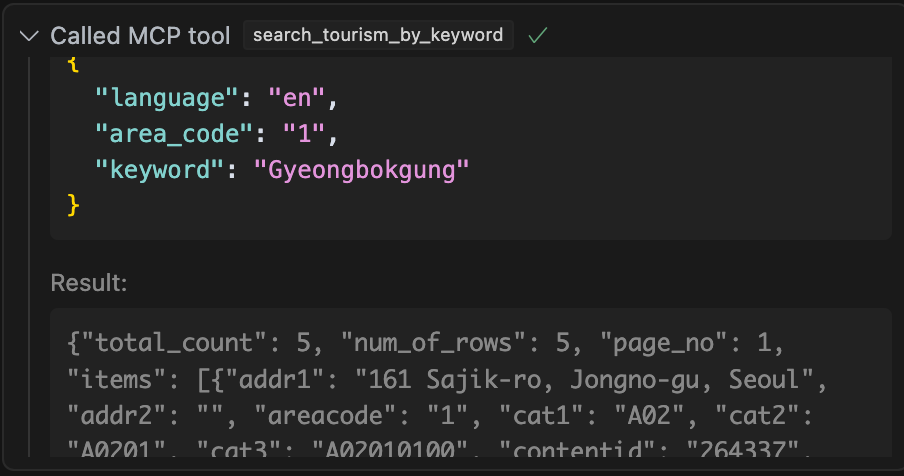
search_tourism_by_keyword: Search for tourism information using keywords (e.g., “Gyeongbokgung”, “Bibimbap”). Filter by content type, area code.
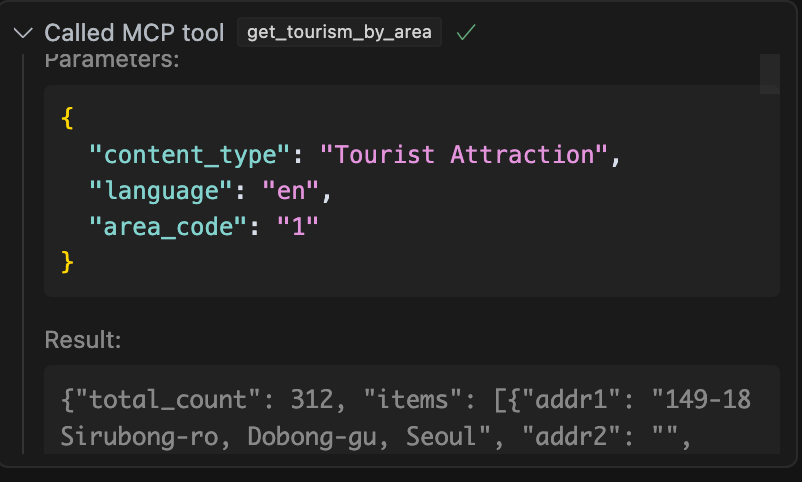
get_tourism_by_area: Browse tourism information by geographic area codes (e.g., Seoul=‘1’). Filter by content type, district code.
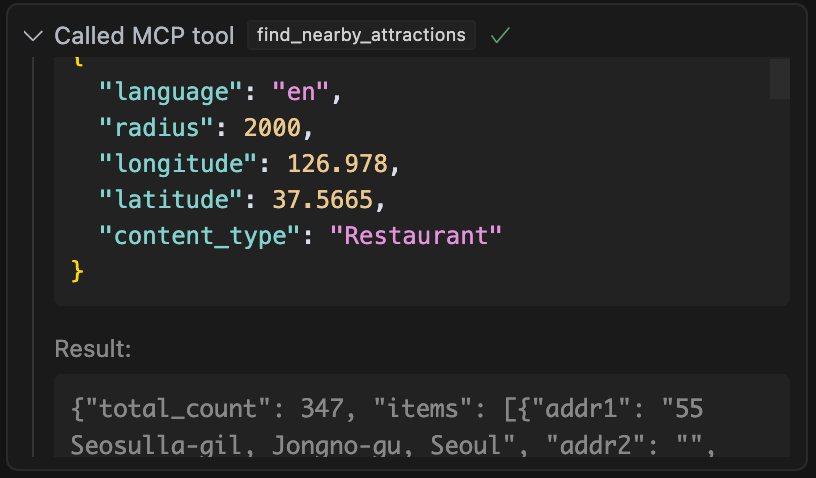
find_nearby_attractions: Discover tourism spots near specific GPS coordinates (longitude, latitude). Filter by radius and content type.
search_festivals_by_date: Find festivals occurring within a specified date range (YYYYMMDD). Filter by area code.
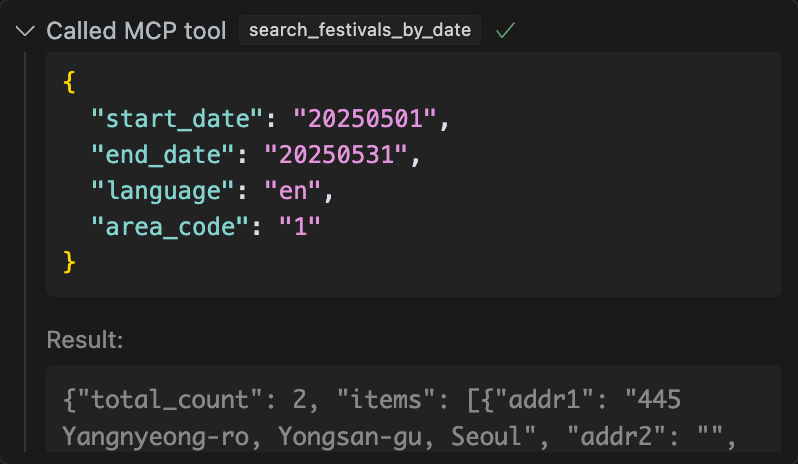
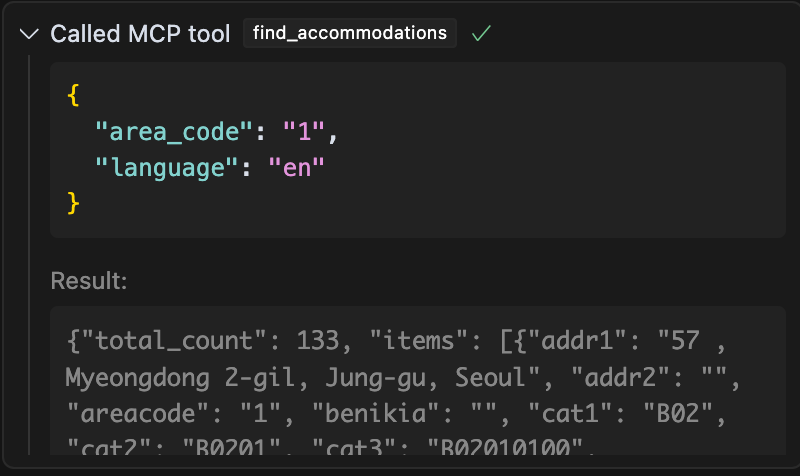
find_accommodations: Search for hotels, guesthouses, etc. Filter by area and district code.
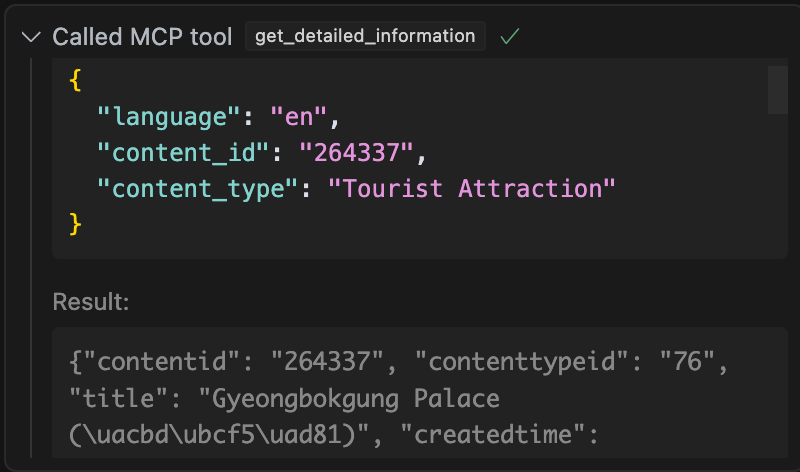
get_detailed_information: Retrieve comprehensive details (overview, usage time, parking, etc.) for a specific item using its Content ID. Filter by content type.
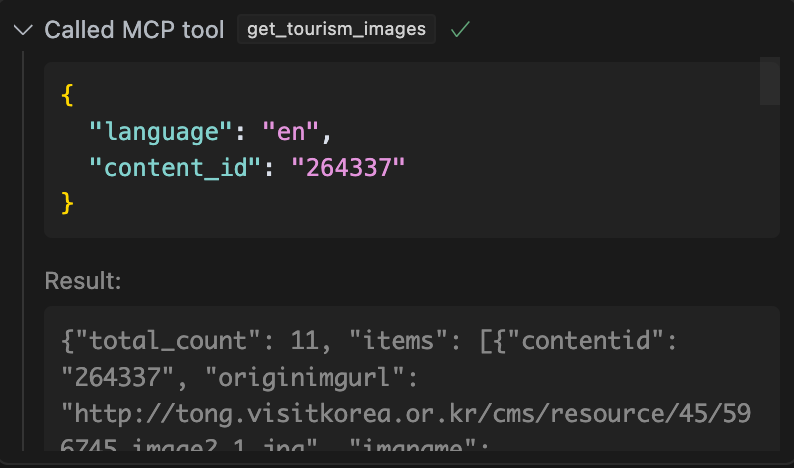
get_tourism_images: Get image URLs associated with a specific tourism item using its Content ID.
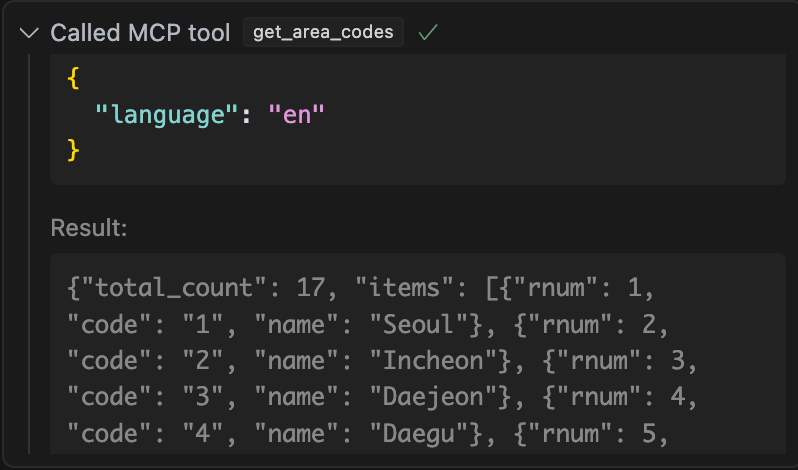
get_area_codes: Retrieve area codes (for cities/provinces) and optionally sub-area (district) codes.
⚙️ Requirements (for uv method)
- Python 3.12+
uvinstalled (pip install uv)
Example Usage
An AI assistant integrated with this MCP could handle queries like:
- “Find restaurants near Myeongdong station.”
- “Show me pictures of Bulguksa Temple.”
- “Are there any festivals in Busan next month?”
- “Tell me more about Gyeongbokgung Palace, content ID 264337.”
Dev Tools Supporting MCP
The following are the main code editors that support the Model Context Protocol. Click the link to visit the official website for more information.







