
Mcp Server Sample
What is Mcp Server Sample
mcp-server-sample is an implementation of a Model Context Protocol (MCP) server designed for educational purposes. It serves as a demonstration of how to build a functional MCP server that can integrate with various LLM clients.
Use cases
Use cases for mcp-server-sample include developing AI applications that require context-aware interactions, creating educational tools that leverage LLMs, and building integrations that allow for flexible data access and manipulation.
How to use
To use mcp-server-sample, clone the repository and follow the setup instructions in the README. You can then run the server and connect it with LLM clients to utilize the standardized Model Context Protocol.
Key features
Key features of mcp-server-sample include the ability to integrate with multiple LLM clients, support for various data sources, and the provision of resources, tools, and prompts that enhance the interaction between applications and LLMs.
Where to use
mcp-server-sample can be used in fields such as AI development, educational tools, and any application requiring integration with large language models for enhanced data processing and interaction.
Clients Supporting MCP
The following are the main client software that supports the Model Context Protocol. Click the link to visit the official website for more information.





Overview
What is Mcp Server Sample
mcp-server-sample is an implementation of a Model Context Protocol (MCP) server designed for educational purposes. It serves as a demonstration of how to build a functional MCP server that can integrate with various LLM clients.
Use cases
Use cases for mcp-server-sample include developing AI applications that require context-aware interactions, creating educational tools that leverage LLMs, and building integrations that allow for flexible data access and manipulation.
How to use
To use mcp-server-sample, clone the repository and follow the setup instructions in the README. You can then run the server and connect it with LLM clients to utilize the standardized Model Context Protocol.
Key features
Key features of mcp-server-sample include the ability to integrate with multiple LLM clients, support for various data sources, and the provision of resources, tools, and prompts that enhance the interaction between applications and LLMs.
Where to use
mcp-server-sample can be used in fields such as AI development, educational tools, and any application requiring integration with large language models for enhanced data processing and interaction.
Clients Supporting MCP
The following are the main client software that supports the Model Context Protocol. Click the link to visit the official website for more information.
Content
MCP Server Sample
This repository contains an implementation of a Model Context Protocol (MCP) server for educational purposes. This code demonstrates how to build a functional MCP server that can integrate with various LLM clients.
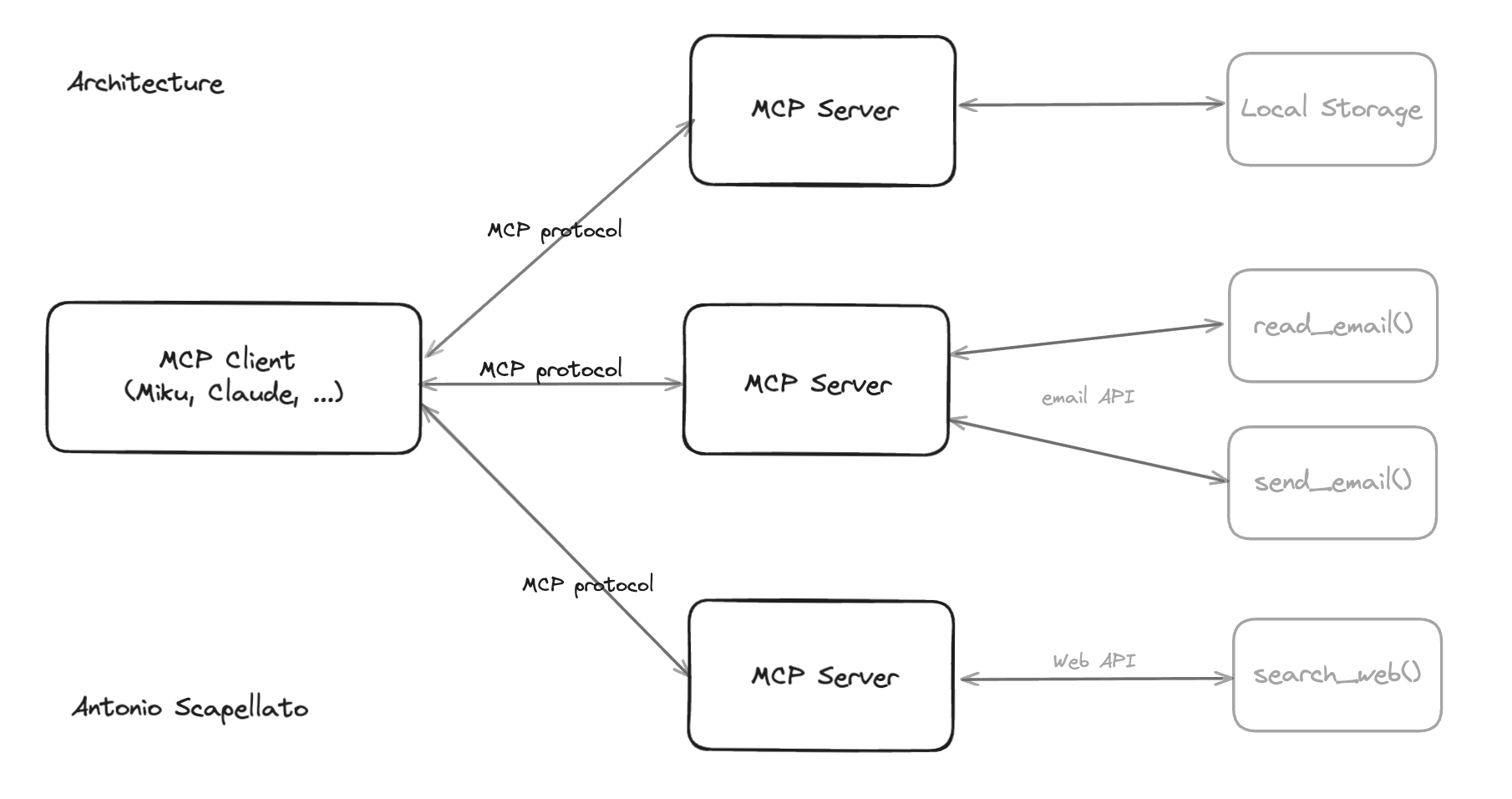
MCP Server Example
This repository contains an implementation of a Model Context Protocol (MCP) server for educational purposes. This code demonstrates how to build a functional MCP server that can integrate with various LLM clients.
References:
What is MCP?
MCP (Model Context Protocol) is an open protocol that standardizes how applications provide context to LLMs. Think of MCP like a USB-C port for AI applications - it provides a standardized way to connect AI models to different data sources and tools.
Key Benefits
- A growing list of pre-built integrations that your LLM can directly plug into
- Flexibility to switch between LLM providers and vendors
- Best practices for securing your data within your infrastructure
Architecture Overview
MCP follows a client-server architecture where a host application can connect to multiple servers:
- MCP Hosts: Programs like Claude Desktop, IDEs, or AI tools that want to access data through MCP
- MCP Clients: Protocol clients that maintain 1:1 connections with servers
- MCP Servers: Lightweight programs that expose specific capabilities through the standardized Model Context Protocol
- Data Sources: Both local (files, databases) and remote services (APIs) that MCP servers can access
Core MCP Concepts
MCP servers can provide three main types of capabilities:
- Resources: File-like data that can be read by clients (like API responses or file contents)
- Tools: Functions that can be called by the LLM (with user approval)
- Prompts: Pre-written templates that help users accomplish specific tasks
System Requirements
- Python 3.10 or higher
- MCP SDK 1.2.0 or higher
uvpackage manager
Installation
Adding MCP to your python project
We recommend using uv to manage your Python projects.
If you haven’t created a uv-managed project yet, create one:
uv init mcp-server-sample
cd mcp-server-sample
Then add MCP to your project dependencies:
uv add "mcp[cli]
Alternatively, for projects using pip for dependencies:
pip install "mcp[cli]"
Running the standalone MCP development tools
To run the mcp command with uv:
uv run mcp
Quickstart
Let’s create a simple MCP server that exposes a calculator tool and some data:
# server.py
from mcp.server.fastmcp import FastMCP

# Create an MCP server
mcp = FastMCP("Demo")


# Add an addition tool
@mcp.tool()
def add(a: int, b: int) -> int:
    """Add two numbers"""
    return a + b


# Add a dynamic greeting resource
@mcp.resource("greeting://{name}")
def get_greeting(name: str) -> str:
    """Get a personalized greeting"""
    return f"Hello, {name}!"
You can install this server in Claude Desktop and interact with it right away by running:
mcp install server.py
Alternatively, you can test it with the MCP Inspector:
mcp dev server.py
Made with ❤️ by Antonio Scapellato
Resources:
License
This project is licensed under the MIT License. See the LICENSE file for details.
Dev Tools Supporting MCP
The following are the main code editors that support the Model Context Protocol. Click the link to visit the official website for more information.







