
Mcp Stdio To Streamable Http Adapter
What is Mcp Stdio To Streamable Http Adapter
mcp-stdio-to-streamable-http-adapter is a proxy that allows interaction between STDIO MCP Servers and Streamable HTTP MCP Servers, enabling compatibility for various MCP Clients.
Use cases
Use cases include integrating legacy MCP Clients with modern Streamable HTTP Servers, developing applications that require real-time data streaming, and enhancing compatibility for various MCP-based tools.
How to use
To use mcp-stdio-to-streamable-http-adapter, configure the server settings in your application, specifying the URI of the Streamable HTTP MCP Server and optional parameters like MCP_NAME and BEARER_TOKEN. You can integrate it via npx in your Claude Desktop configuration.
Key features
Key features include seamless integration with existing STDIO MCP Clients, support for Streamable HTTP transport, and the ability to relay data between different MCP server types.
Where to use
mcp-stdio-to-streamable-http-adapter is useful in scenarios where developers need to connect traditional STDIO MCP Clients with newer Streamable HTTP MCP Servers, particularly in AI and machine learning applications.
Clients Supporting MCP
The following are the main client software that supports the Model Context Protocol. Click the link to visit the official website for more information.





Overview
What is Mcp Stdio To Streamable Http Adapter
mcp-stdio-to-streamable-http-adapter is a proxy that allows interaction between STDIO MCP Servers and Streamable HTTP MCP Servers, enabling compatibility for various MCP Clients.
Use cases
Use cases include integrating legacy MCP Clients with modern Streamable HTTP Servers, developing applications that require real-time data streaming, and enhancing compatibility for various MCP-based tools.
How to use
To use mcp-stdio-to-streamable-http-adapter, configure the server settings in your application, specifying the URI of the Streamable HTTP MCP Server and optional parameters like MCP_NAME and BEARER_TOKEN. You can integrate it via npx in your Claude Desktop configuration.
Key features
Key features include seamless integration with existing STDIO MCP Clients, support for Streamable HTTP transport, and the ability to relay data between different MCP server types.
Where to use
mcp-stdio-to-streamable-http-adapter is useful in scenarios where developers need to connect traditional STDIO MCP Clients with newer Streamable HTTP MCP Servers, particularly in AI and machine learning applications.
Clients Supporting MCP
The following are the main client software that supports the Model Context Protocol. Click the link to visit the official website for more information.
Content
mcp-stdio-to-streamable-http-adapter MCP Server
Integrate any MCP Client that has STDIO MCP Server Support (most do) with the Streamable HTTP MCP Servers
Note: This has similarities to the mcp-remote package
Why?
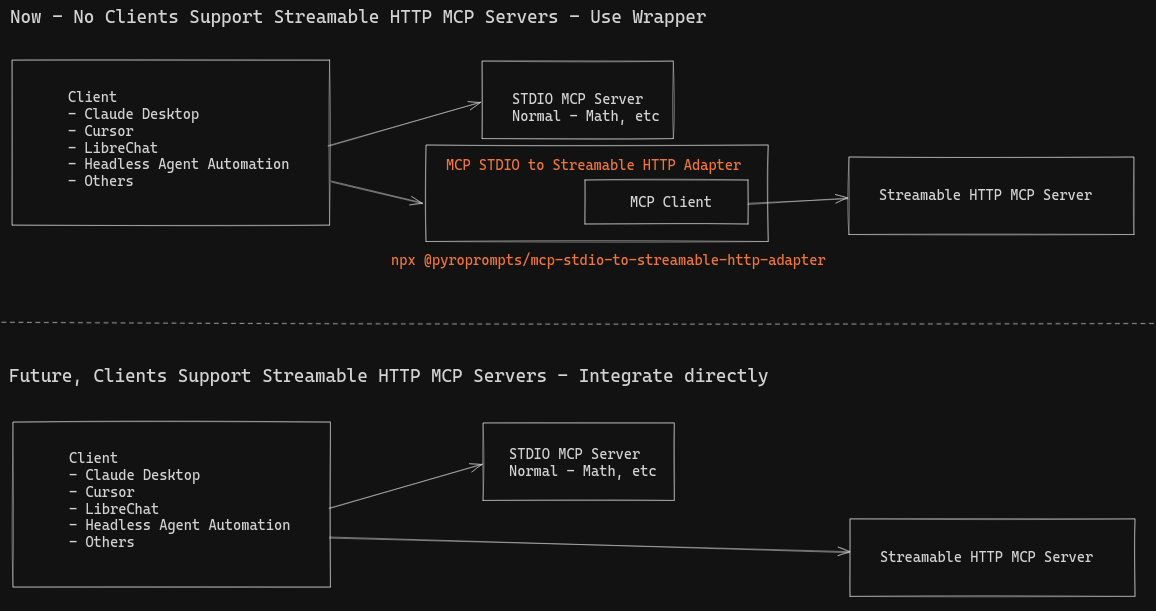
The MCP Spec to add a Streamable HTTP Transport landed end of March 2025 and as of the end of April, no clients have adopted support. The typescript-sdk has merged the code, but not released. The Python SDK is still in development to support it. The Inspector supports it, but that’s it.
This leaves developers in an awkward position. Develop the MCP Server using STDIO or SSE (deprecated) so it works with clients or develop with Streamable HTTP transport, but nobody can use it.
I (ferrants) want to start integrating the Streamable HTTP MCP Servers beyond just the inspector, so I need a way to connect them to clients and LLMs right away!
This package aims to bridge the cap by being a STDIO MCP Server that relays to your Streamable HTTP MCP Server. This makes all MCP Clients support Streamable HTTP right away. And now developers can develop the Streamable HTTP MCP Servers and provide an installation method.
Installation
To add OpenAI to Claude Desktop, add the server config:
On MacOS: ~/Library/Application Support/Claude/claude_desktop_config.json
On Windows: %APPDATA%/Claude/claude_desktop_config.json
Env Vars
URI: The URL of the Streamable HTTP MCP Server. This is required.MCP_NAME: The name of the MCP Server. This is optional. If you configure multiple, this is required so they do not have the same names.BEARER_TOKEN: The Bearer token for the Streamable HTTP MCP Server. This is optional. If specified, this will be sent along in the Authorization header.
Configuration
You can use it via npx in your Claude Desktop configuration like this:
{
  "mcpServers": {
    "my-saas-app-development": {
      "command": "npx",
      "args": [
        "@pyroprompts/mcp-stdio-to-streamable-http-adapter"
      ],
      "env": {
        "URI": "http://localhost:3002/mcp",
        "MCP_NAME": "local-custom-streamable-http-adapter"
      }
    }
  }
}
Or, if you clone the repo, you can build and use in your Claude Desktop configuration like this:
{
  "mcpServers": {
    "my-saas-app-development": {
      "command": "node",
      "args": [
        "/path/to/mcp-stdio-to-streamable-http-adapter/build/index.js"
      ],
      "env": {
        "URI": "http://localhost:3002/mcp",
        "MCP_NAME": "local-custom-streamable-http-adapter"
      }
    }
  }
}
You can add multiple providers by referencing the same MCP server multiple times, but with different env arguments:
{
  "mcpServers": {
    "my-saas-app-development": {
      "command": "node",
      "args": [
        "/path/to/mcp-stdio-to-streamable-http-adapter/build/index.js"
      ],
      "env": {
        "URI": "http://localhost:3002/mcp",
        "MCP_NAME": "local-custom-streamable-http-adapter"
      }
    },
    "pyroprompts": {
      "command": "node",
      "args": [
        "/path/to/mcp-stdio-to-streamable-http-adapter/build/index.js"
      ],
      "env": {
        "URI": "https://api.pyroprompts.com/mcp",
        "MCP_NAME": "pyroprompts",
        "BEARER_TOKEN": "abcdefg"
      }
    }
  }
}
With these three, you’ll see a tool for each in the Claude Desktop Home:

And then you can chat with other LLMs and it shows in chat like this:

Or, configure in LibreChat like:
  my-saas-app-development:
    type: stdio
    command: npx
    args:
      - -y
      - @pyroprompts/mcp-stdio-to-streamable-http-adapter
    env:
      URI: "http://localhost:3002/mcp",
      MCP_NAME: "my-custom-saas-app"
      PATH: '/usr/local/bin:/usr/bin:/bin'
And it shows in LibreChat:

Development
Install dependencies:
npm install
Build the server:
npm run build
For development with auto-rebuild:
npm run watch
Debugging
Since MCP servers communicate over stdio, debugging can be challenging. We recommend using the MCP Inspector, which is available as a package script:
npm run inspector
The Inspector will provide a URL to access debugging tools in your browser.
Acknowledgements
- Obviously the modelcontextprotocol and Anthropic teams for the MCP Specification and integration into Claude Desktop. https://modelcontextprotocol.io/introduction
- PyroPrompts for sponsoring this project. Use code
MCPSTREAMABLEADAPTERfor 20 free automation credits on Pyroprompts.
Dev Tools Supporting MCP
The following are the main code editors that support the Model Context Protocol. Click the link to visit the official website for more information.







