
Mcp Vulnerability Scanner
What is Mcp Vulnerability Scanner
The mcp-vulnerability-scanner is a Model Context Protocol (MCP) server designed for scanning IP addresses to identify vulnerabilities. It provides tools for both individual and batch scanning of IPs.
Use cases
Use cases include scanning corporate networks for vulnerabilities, assessing the security of web servers, performing penetration testing, and ensuring compliance with security standards.
How to use
To use the mcp-vulnerability-scanner, clone the repository, install the necessary dependencies using npm, and optionally install Nmap for enhanced scanning capabilities. Configure the server using the provided JSON files, and run it to start scanning IP addresses.
Key features
Key features include multiple vulnerability scanning methods (Nmap and API-based checks), support for single and batch IP scanning, detailed reports on vulnerabilities including severity, descriptions, and remediation steps, and easy integration with MCP clients.
Where to use
The mcp-vulnerability-scanner can be used in various fields such as cybersecurity, network administration, and IT security assessments to identify and mitigate vulnerabilities in networked systems.
Clients Supporting MCP
The following are the main client software that supports the Model Context Protocol. Click the link to visit the official website for more information.





Overview
What is Mcp Vulnerability Scanner
The mcp-vulnerability-scanner is a Model Context Protocol (MCP) server designed for scanning IP addresses to identify vulnerabilities. It provides tools for both individual and batch scanning of IPs.
Use cases
Use cases include scanning corporate networks for vulnerabilities, assessing the security of web servers, performing penetration testing, and ensuring compliance with security standards.
How to use
To use the mcp-vulnerability-scanner, clone the repository, install the necessary dependencies using npm, and optionally install Nmap for enhanced scanning capabilities. Configure the server using the provided JSON files, and run it to start scanning IP addresses.
Key features
Key features include multiple vulnerability scanning methods (Nmap and API-based checks), support for single and batch IP scanning, detailed reports on vulnerabilities including severity, descriptions, and remediation steps, and easy integration with MCP clients.
Where to use
The mcp-vulnerability-scanner can be used in various fields such as cybersecurity, network administration, and IT security assessments to identify and mitigate vulnerabilities in networked systems.
Clients Supporting MCP
The following are the main client software that supports the Model Context Protocol. Click the link to visit the official website for more information.
Content
MCP Vulnerability Scanner
A Model Context Protocol (MCP) server for scanning IP addresses for vulnerabilities. This server provides tools to perform security scanning on individual IPs or multiple IPs at once.
Features
- Scan IP addresses for vulnerabilities using multiple methods:
- Nmap vulnerability scanning
- API-based vulnerability checks
- Supports single IP scanning or batch scanning of multiple IPs
- Returns detailed reports with vulnerability severity, descriptions, and remediation steps
- Implements the Model Context Protocol for easy integration with MCP clients
Prerequisites
- Node.js (v14.x or higher)
- npm (v7.x or higher)
- Nmap (optional, for enhanced scanning capabilities)
Installation
-
Clone this repository:
git clone <repository-url> cd mcp-vulnerability-scanner -
Install dependencies:
npm install -
Install Nmap (optional but recommended):
# For Ubuntu/Debian
sudo apt-get update
sudo apt-get install nmap

# For CentOS/RHEL
sudo yum install nmap

# For macOS
brew install nmap
Configuration
The MCP Vulnerability Scanner is configured through the following files:
1. .mcp.json
This is the main MCP configuration file:
{
  "name": "vulnerability-scanner",
  "version": "1.0.0",
  "description": "An MCP server for scanning vulnerabilities on IP addresses",
  "command": "npm",
  "args": [
    "run",
    "dev"
  ],
  "capabilities": {
    "contextItemTypes": [
      "ip"
    ]
  }
}
2. Integration with VS Code
For VS Code integration, the configuration is in .vscode/mcp.json:
{
  "mcpServers": {
    "mcp_vuln": {
      "command": "npm",
      "args": [
        "run",
        "dev",
        "mcp-vulnerability-scanner",
        "--prefix",
        "/path/to/mcp-vulnerability-scanner"
      ],
      "env": {
        "MCP_SERVER_PORT": "3000"
      }
    }
  }
}
Update the --prefix path to point to your installation location.
Usage Example
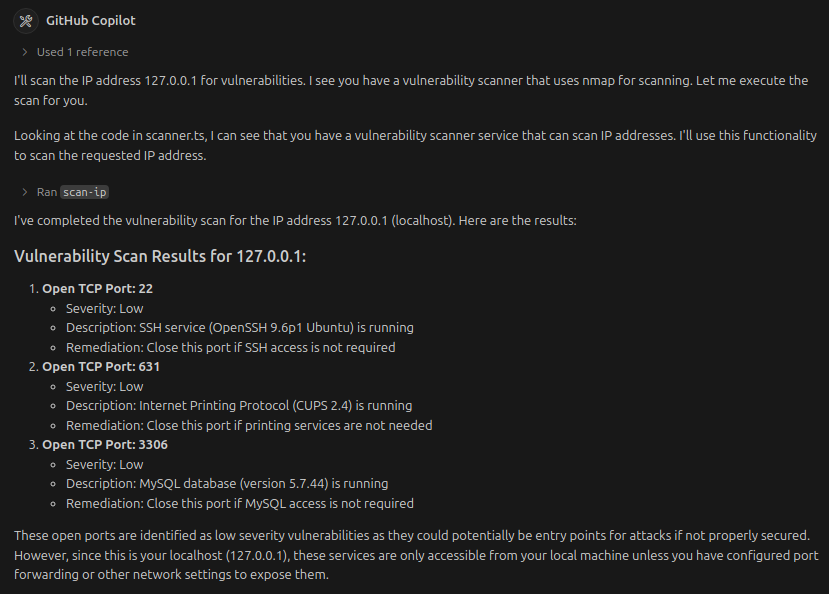
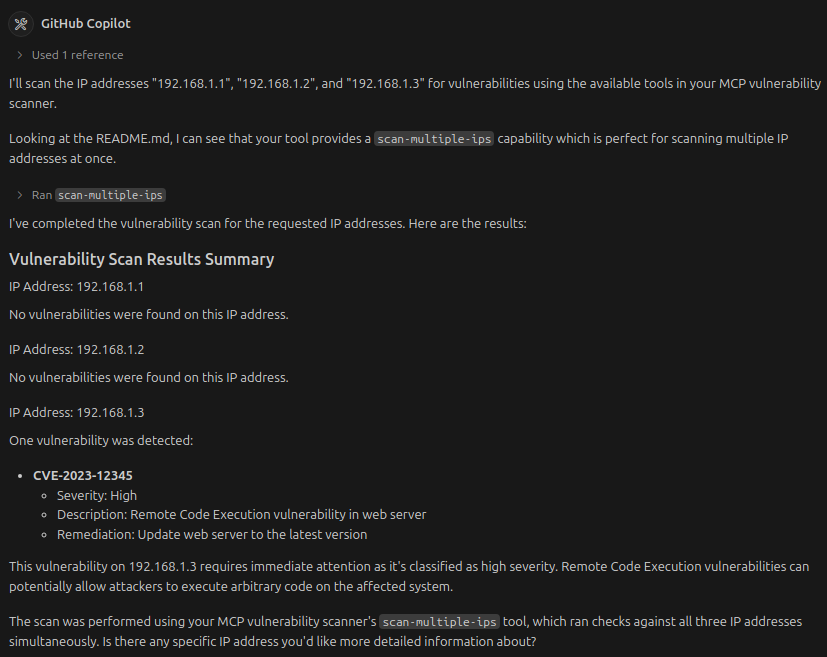
Below is a example showing the vulnerability scanner in action:
- Single Ip Addess scan
- Multiple Ip Addess scan
Available Tools
This MCP server provides the following tools:
1. scan-ip
Scans a single IP address for vulnerabilities.
Parameters:
ip: The IP address to scan (string)
Example usage:
scan-ip 192.168.1.1
2. scan-multiple-ips
Scans multiple IP addresses for vulnerabilities.
Parameters:
ips: Array of IP addresses to scan (string[])
Example usage:
scan-multiple-ips ["192.168.1.1", "192.168.1.2", "192.168.1.3"]
Deployment Options
1. Local Development
Run the server in development mode:
npm run dev
2. Build and Run in Production
npm run build
npm start
3. Docker Deployment
Create a Dockerfile in the project root:
FROM node:18-alpine

# Install Nmap
RUN apk add --no-cache nmap

WORKDIR /app

COPY package*.json ./
RUN npm ci

COPY . .
RUN npm run build

EXPOSE 3000

CMD ["npm", "start"]
Build and run the Docker container:
docker build -t mcp-vulnerability-scanner .
docker run -p 3000:3000 mcp-vulnerability-scanner
4. VS Code Extension Integration
To use this server in VS Code:
- Configure the
.vscode/mcp.jsonfile as shown above - Ensure the path to the server is correctly set
- The server will be available to MCP-enabled extensions
Security Considerations
- This scanner requires administrative/root permissions to run comprehensive Nmap scans
- Only scan IP addresses that you have permission to scan
- Be aware that vulnerability scanning might trigger security systems or IDS alerts
- The scan results are provided for informational purposes only
License
MIT
Dev Tools Supporting MCP
The following are the main code editors that support the Model Context Protocol. Click the link to visit the official website for more information.







