
Meta Mcp Proxy
What is Meta Mcp Proxy
Meta MCP Proxy is a flexible Model Context Protocol (MCP) proxy that facilitates the discovery and execution of tools across multiple MCP servers and JavaScript functions, optimizing context size for large toolsets.
Use cases
Use cases for Meta MCP Proxy include managing complex workflows that require tool integration, enhancing API interactions, and optimizing the execution of JavaScript functions within an MCP environment.
How to use
To use Meta MCP Proxy, edit the configuration file located at ‘~/Library/Application Support/Claude/claude_desktop_config.json’ to include the MCP server details and specify the command and arguments for execution.
Key features
Key features include unified tool discovery across multiple MCP servers, proxy execution for routing tool calls, smart search capabilities with fuzzy matching, integration of custom JavaScript functions, and configurable settings through files or command-line arguments.
Where to use
Meta MCP Proxy can be used in various fields such as software development, data processing, and any application requiring integration of multiple tools and services through MCP servers.
Clients Supporting MCP
The following are the main client software that supports the Model Context Protocol. Click the link to visit the official website for more information.





Overview
What is Meta Mcp Proxy
Meta MCP Proxy is a flexible Model Context Protocol (MCP) proxy that facilitates the discovery and execution of tools across multiple MCP servers and JavaScript functions, optimizing context size for large toolsets.
Use cases
Use cases for Meta MCP Proxy include managing complex workflows that require tool integration, enhancing API interactions, and optimizing the execution of JavaScript functions within an MCP environment.
How to use
To use Meta MCP Proxy, edit the configuration file located at ‘~/Library/Application Support/Claude/claude_desktop_config.json’ to include the MCP server details and specify the command and arguments for execution.
Key features
Key features include unified tool discovery across multiple MCP servers, proxy execution for routing tool calls, smart search capabilities with fuzzy matching, integration of custom JavaScript functions, and configurable settings through files or command-line arguments.
Where to use
Meta MCP Proxy can be used in various fields such as software development, data processing, and any application requiring integration of multiple tools and services through MCP servers.
Clients Supporting MCP
The following are the main client software that supports the Model Context Protocol. Click the link to visit the official website for more information.
Content
Meta MCP Proxy
A flexible Model Context Protocol (MCP) proxy that enables discovery and execution of tools across multiple MCP servers and JavaScript functions. Enabling to have a reduced context event if you have houndreds of tools.
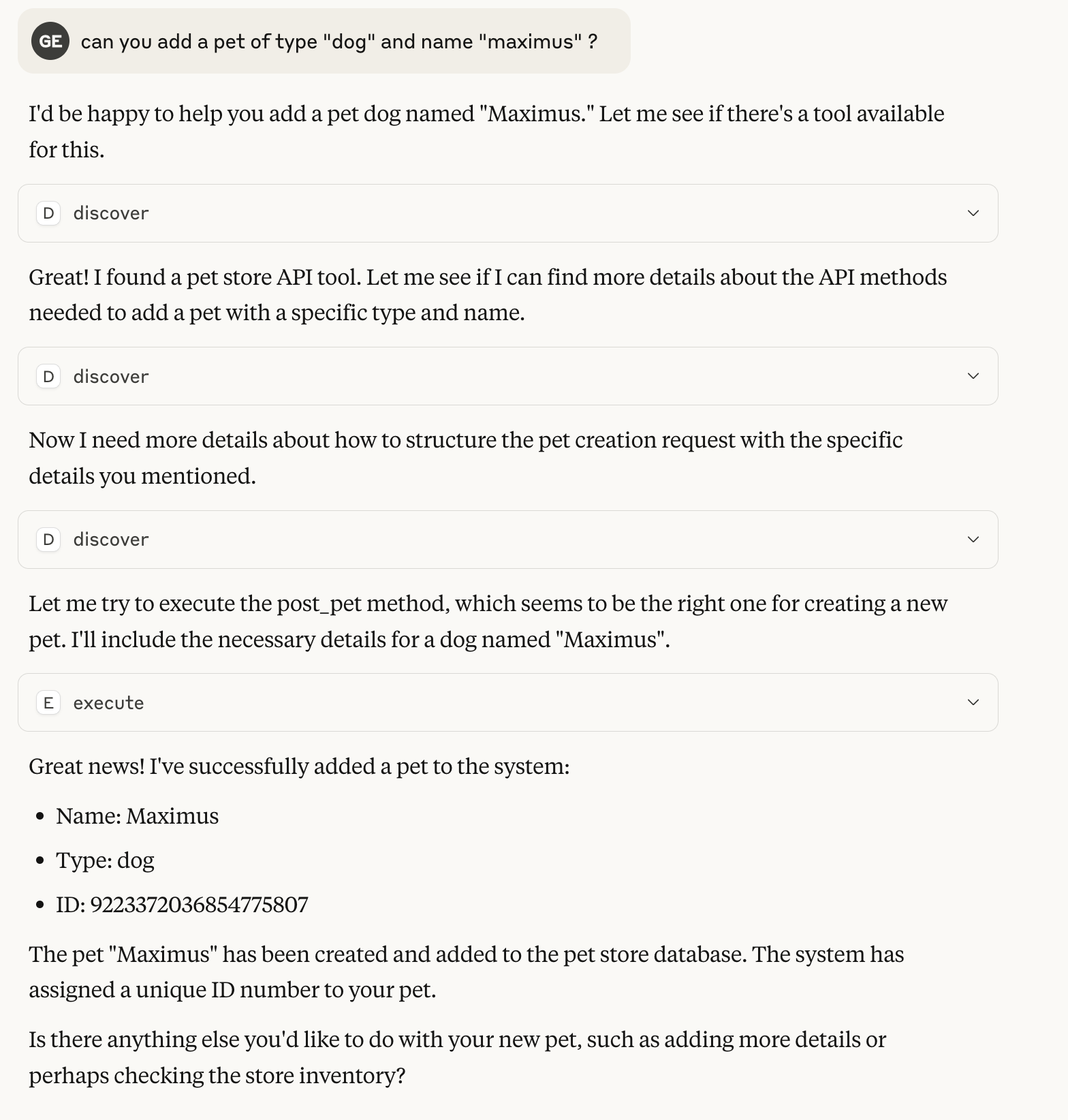
This mcp act as wrapper of other mcps (or libraries) doing a kind of Local RAG (Retrieval Augmented Generation) to reduce the context size providing the llm with 2 methods (discover and execute) and asking the llm to be concise about discovery. The execute method is a simple proxy
We extremely recommends add the configuration discoverDescriptionExtras to extends in details about the purpose of the tools and for what kind of topics the llm should use it.
Features
- 🌉 Unified Tool Discovery: Search for tools across multiple MCP servers
- 🔌 Proxy Execution: Route tool calls to the appropriate server
- 🔍 Smart Search: Find the best tool for the job with fuzzy matching
- 🧩 JavaScript Integration: Expose custom JavaScript functions as MCP tools
- 📝 Configurable: Load configuration from files or command-line arguments
Usage
🧱 Installation
Edit your file ~/Library/Application Support/Claude/claude_desktop_config.json
and add the following
{
  "mcpServers": {
    "mcp-openapi-proxy": {
      "command": "npx",
      "args": [
        "@nullplatform/meta-mcp-proxy",
        "-f",
        "config.json"
      ]
    }
  }
}
Configuration File Format
Your config.json should follow this structure:
{
  "discoverDescriptionExtras": "Additional description for discovery",
  "discoverLimit": 10,
  "mcpServers": {
    "server-name": {
      "command": "command-to-execute",
      "args": [
        "arg1",
        "arg2"
      ],
      "env": {
        "ENV_VAR1": "value1",
        "ENV_VAR2": "value2"
      },
      "transport": "stdio"
    }
  }
}
as example
{
  "discoverDescriptionExtras": "Api used to manage a pet store with access to pets, pet types, users, orders and store",
  "mcpServers": {
    "mcp-petstore": {
        "command": "uvx",
        "args": ["mcp-openapi-proxy"],
        "env": {
            "OPENAPI_SPEC_URL": "https://petstore.swagger.io/v2/swagger.json",
            "API_KEY": "xxxxx"
       }
    }
  }
}
Example 0-Shot conversation with Claude
the example is using the demo config with the pet store with almost no description of what the api
As a Library
You can also use Meta MCP Proxy as a library in your own JavaScript applications:
import { MCPProxy } from '@nullplatform/meta-mcp-proxy';

// Create a new proxy instance
const mcpProxy = new MCPProxy({
  mcpServers: {
    "my-server": {
      "command": "path/to/server",
      "args": [],
      "env": {}
    }
  },
  discoverLimit: 10
});

// Register a custom JavaScript function
mcpProxy.registerJsFunction(
  "myFunction",
  "Description of my function",
  {
    properties: {
      param1: {
        type: "string",
        description: "First parameter"
      },
      param2: {
        type: "number",
        description: "Second parameter"
      }
    },
    required: ["param1"]
  },
  async ({ param1, param2 }) => {
    // Implementation goes here
    return {
      content: [
        {
          type: "text",
          text: JSON.stringify({ result: `Processed ${param1}` })
        }
      ]
    };
  }
);

// Start the MCP server
await mcpProxy.startMCP();
Example creating an mcp with meta-mcp-proxy as a lib
License
MIT
Dev Tools Supporting MCP
The following are the main code editors that support the Model Context Protocol. Click the link to visit the official website for more information.







